Today In History: The Berlin Wall Goes Up
Freedom is indivisible, and when one man is enslaved, all are not free. When all are free, then we can look forward to that day when this city will be joined as one and this country and this great Continent of Europe in a peaceful and hopeful globe. When that day finally comes, as it will, the people of West Berlin can take sober satisfaction in the fact that they were in the front lines for almost two decades.
All free men, wherever they may live, are citizens of Berlin, and, therefore, as a free man, I take pride in the words "Ich bin ein Berliner."
-- President John F. Kennedy, Remarks at the Rudolph Wilde Platz, Berlin, 26 June 1963. Excerpt from "One Day in Berlin", Transcript from the John F. Kennedy Presidential Library and Museum. Digital Identifier USG-2B-1.
On August 13th, 1961, the German Democratic Republic began constructing an outer concrete wall up to 13 feet high, and an inner one of up to 10 feet, as a guarded barrier that separated East from West Germany. In between, a wide area known as the "death strip", contained nails, wire mesh fencing, anti-vehicle trenches, watch towers, bunkers, and other defenses whose aim was to prevent East Germans from fleeing to the West -- and to punish those that did. The Berlin Wall measured over 96 miles long in total, representing the most telling symbol of the Cold War and "Iron Curtain": a term coined in 1946 by Prime Minister Winston Churchill of the United Kingdom to describe the political, physical, and ideological boundary between the European nations. Soviet supported countries in the East were irreconcilable with the capitalist economies and democratic governments of Western European nations -- and the West in general.
From 1961 until 1989, over 100,000 people tried to escape -- only of which around 5,000 persons were successful. Prior to the construction of the Berlin Wall, it is estimated that three and a half million East Germans crossed the border and defected to the West. By November 8th, 1989, after hundreds of deaths, mass protests, and ultimately peaceful revolutions led by Poland and Hungary, the East German government announced the opening of the border; all GDR citizens were allowed to freely travel to West Berlin and the Federal Republic of Germany. Citizens rushed to tear down the wall, though military deconstruction began in early June of 1990, to be completed in November 1991 . By 1994. the Berlin Wall and all of its fortifications were officially removed.
The following articles are drawn from Proquest Historical Newspapers, which informs and inspires classroom teaching and learning.
- Prittie, T. (1961, Oct 04). 55 Slip Through the Iron Curtain: Crane Driver Defies Bullets to Ram Berlin Wall. The Guardian (1959-2009)
- Hailey, F. H. (1961, Oct 07). Berlin Wall 'Must Come Down,' Brandt Says at Ceremony Here. New York Times (1923-)
- Reds Close Gaps in Berlin Wall: Work Under Floodlights During Night.(1961, Nov 20). Chicago Daily Tribune (1923-1963)
- Binder, D. (1961, Nov 26). Berlin Wall Becomes a 'Living, Growing Thing': East Germans Strengthen Carrier with Many New Foritifications. New York Times (1923-)
- 31 000 Cross Berlin Wall in Single Day. (1963, Dec 23). Los Angeles Times (1923-1995)
- Caruthers, O. (1966, Aug 14). The Berlin Wall Looks Permanent. Los Angeles Times (1923-1995)
- Erb, H. J. (1967, Aug 13). Berlin Wall Now Way of German Life: Reds' Barrier Is 6 Years Old. Chicago Tribune (1963-1996)
- Montgomery, L., & Ryan, E. (2009, Nov 07). Fall of the Berlin Wall: Timeline: A History of the Events That Caused the Berlin Wall to Fall on Nov. 9, 1989. The Christian Science Monitor (1908-)
- Grieshaber, K., & Sopke, K. (2024, Nov 09). Divide Still Echoes for Women 35 Years After Berlin Wall's Fall. The Hartford Courant (2008-)
- Anniversary of Berlin Wall's Fall Celebrated. (2024, Nov 10). Newsday (2010-)
Tips:
- Farber, P. M. (2020). A Wall of Our Own : An American History of the Berlin Wall. The University of North Carolina Press. e-book.
- Heller, A., & Schmidt, P. (2024). Thirty Years After the Berlin Wall: German Unification and Transformation Research. Taylor & Francis. e-book.
- Kephart, B. (2014). Going Over. Chronicle Books. Juvenile ; PZ7.K438 Goi 2014.
- Lutzeier, E. (1992). The Wall. Holiday House. Closed Stacks Juvenile ; PZ7.L979554 Wal 1992.
- Schweizer, P., & Schweizer, P. (2000). The Fall of the Berlin Wall : Reassessing the Causes and Consequences of the End of the Cold War. Hoover Institution Press Stanford University. e-book.
Images:
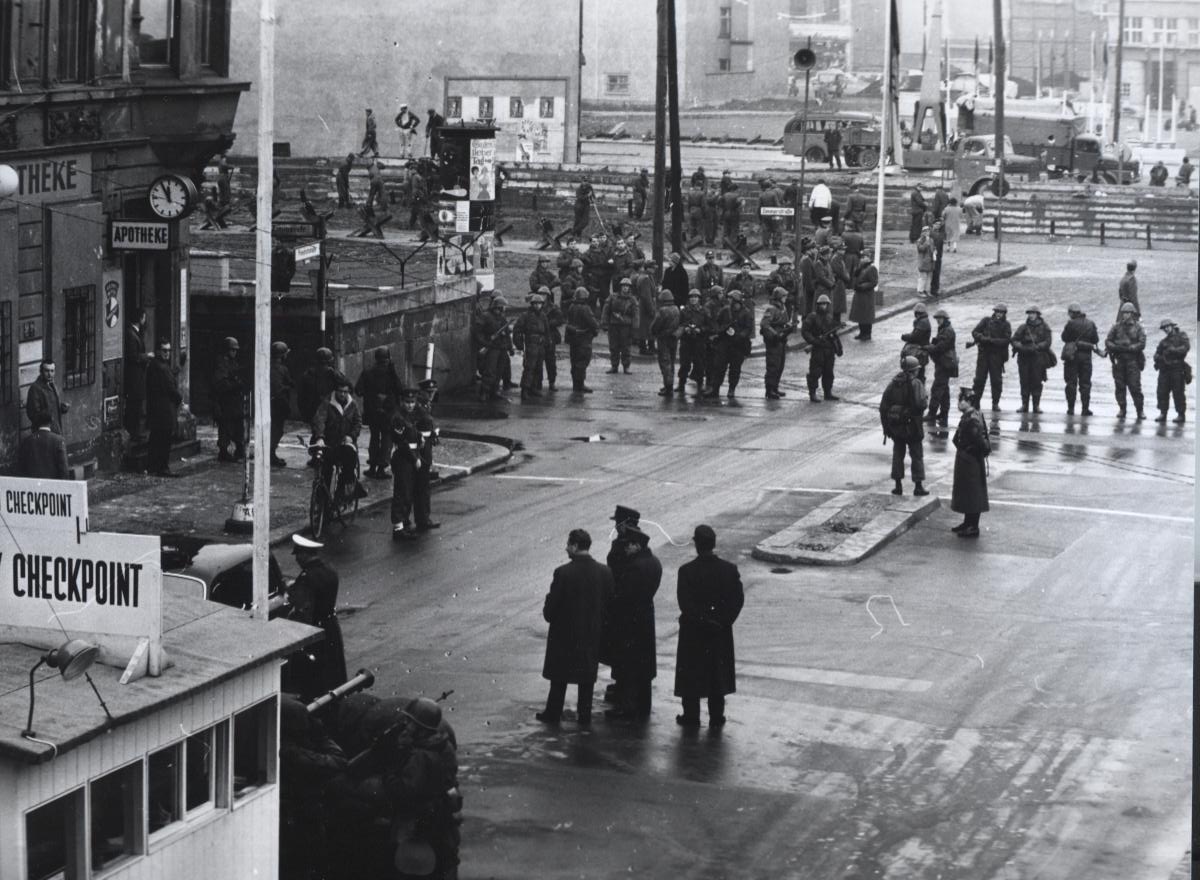
- Behind a Thick Barrier of Military Equipped Volksarmy the Volkspolice and Construction Workers Erect a Tank Barrier at the Border Crossing "Friedrichstrasse". December 4, 1961 . NAID: 6003175. Courtesy of the National Archives.
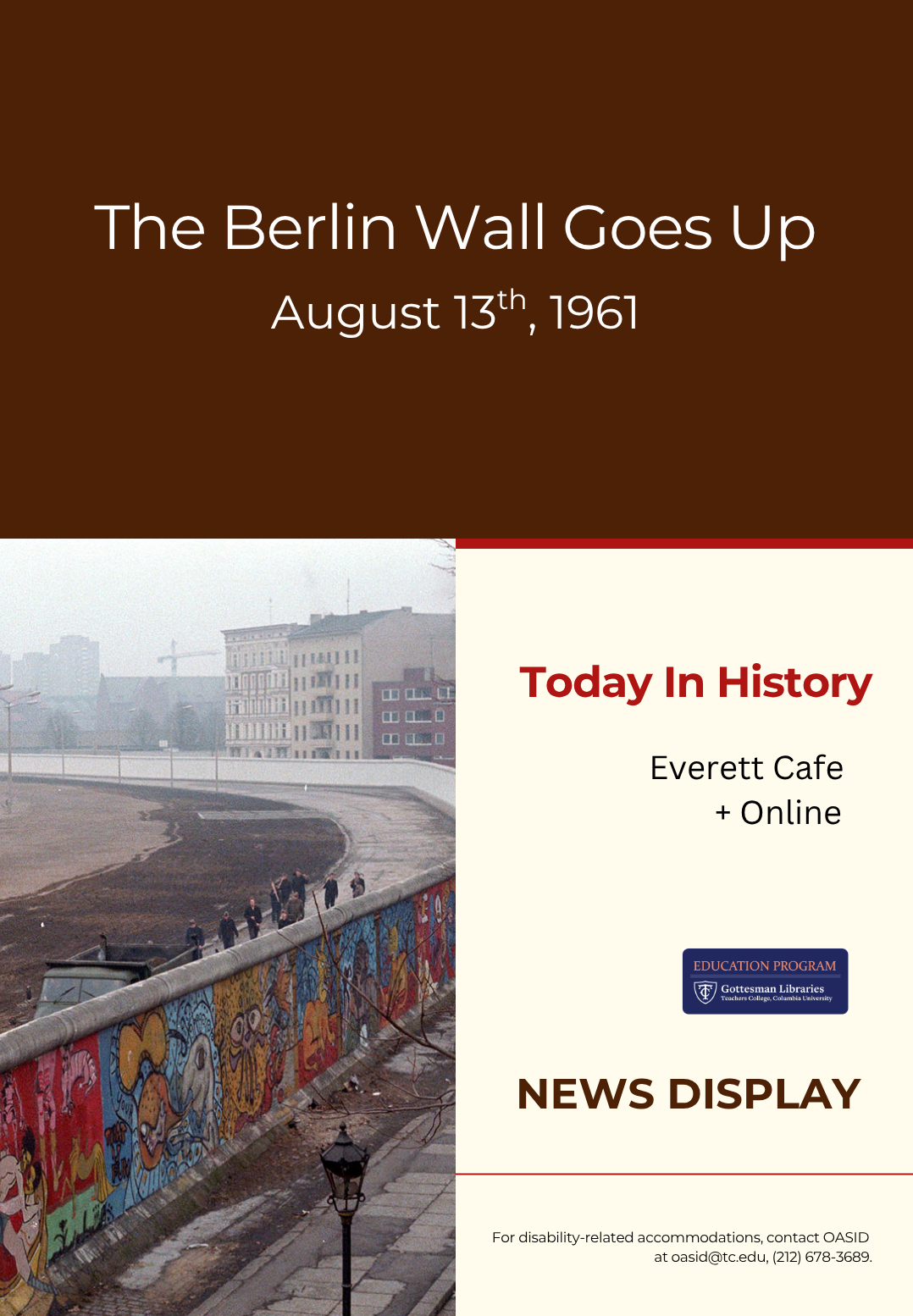
- Poster Image: Berlinmauer, by Thierry Noir. Berlin Wall, View from West Berlin in 1986. Wikimedia Commons.
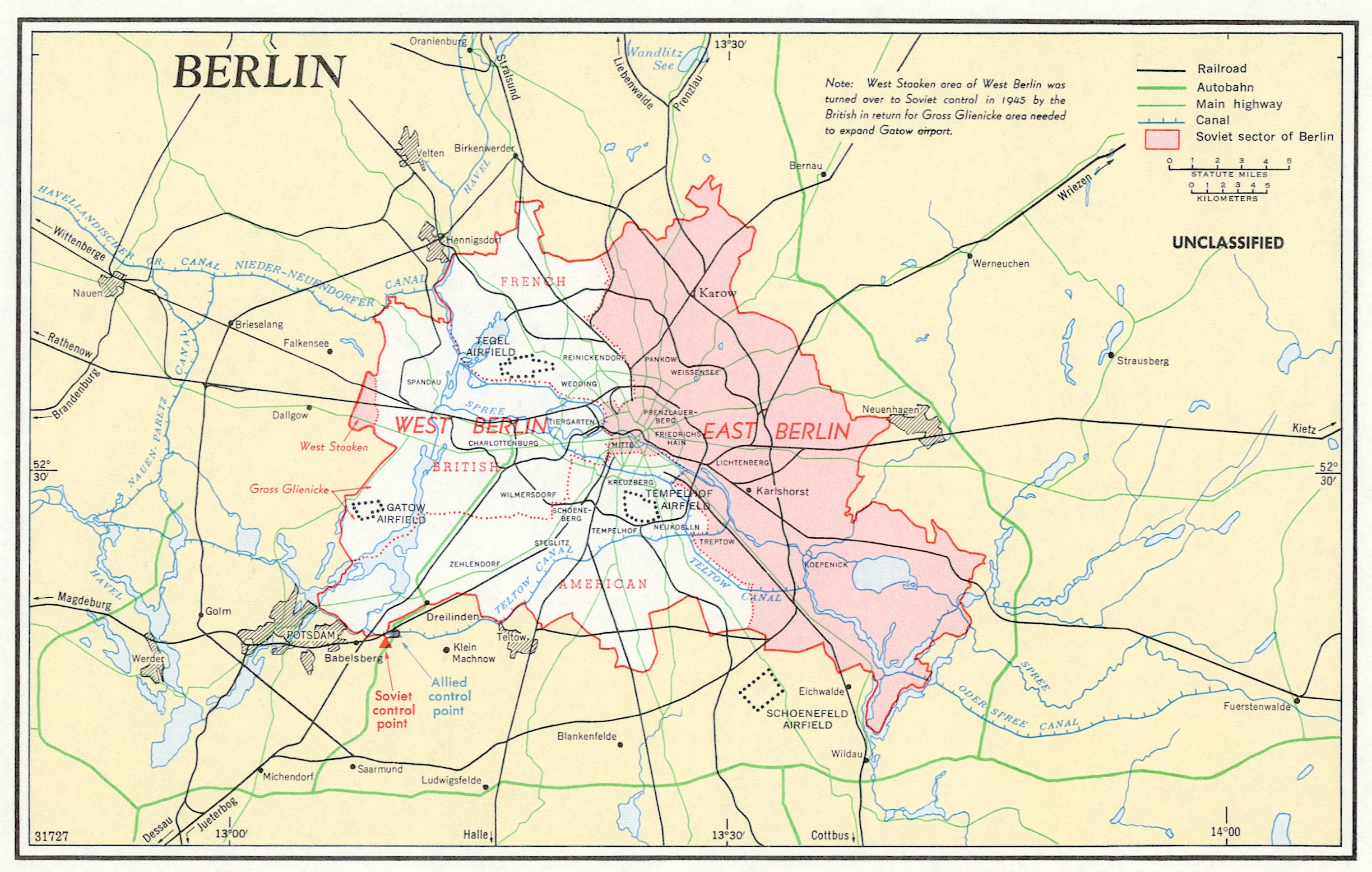
- Berlin (Germany). Includes West Berlin (French, British, American) and East Berlin (Soviet sector). NAID: 266782448. Courtesy of the National Archives..
Need to keep current, look to the past, teach a topic? The Everett Cafe features daily postings of news from around the world, and also promotes awareness of historical events from an educational context. Be sure to check additional Cafe News postings on the library blog.