Today In History: Four Freedoms
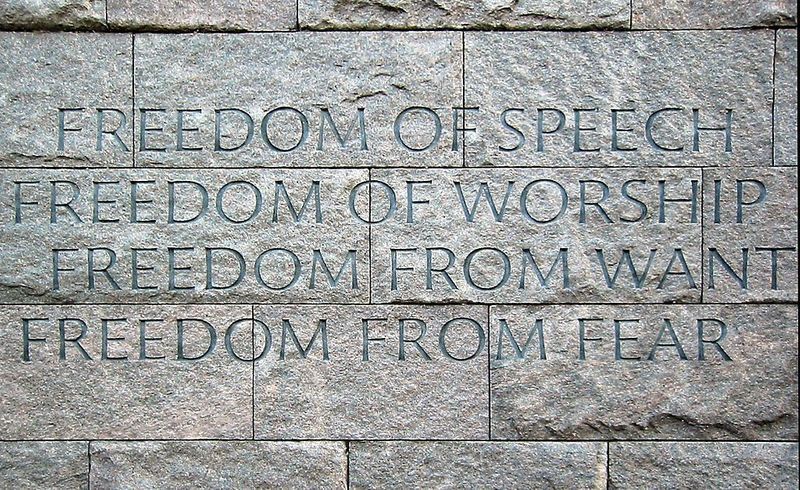
“In the future days, which we seek to make secure, we look forward to a world founded upon four essential human freedoms."
-Franklin Roosevelt, Annual Message to Congress, January 6, 1941
On January 6th, 1941, President Franklin Delano Roosevelt delivered a highly significant State of the Union Address; he outlined continuing support from the United States as a supplier of ammunition, airplanes, tanks, food, and raw materials to the British and Allied forces, and then articulated a clear, strong vision of the four fundamental human freedoms: freedom of speech; freedom of worship, freedom from want, and freedom from fear. Delivered after a lengthy pause in his speech, Roosevelt's striking remarks helped unite the world post-WW2, with similar foundational values and principles later expressed in Winston Churchill's Atlantic Charter; the Declaration of the United Nations; and the Universal Declaration of Human Rights.
The German army and Axis powers were advancing, with war raging in Europe and North Africa. Italy had launched a counter-offensive attack in Albania against the Greeks (the first of 46 Italian raids). Great Britain and Australia poised troops for military action in Libya, South Africa, and other parts of the African continent. Despite many Americans wishing to remain "isolationist" and avoid involvement in international conflict, the United States decided to enter full combat in December 1941 following the Japanese bombing of Pearl Harbor in Hawaii.
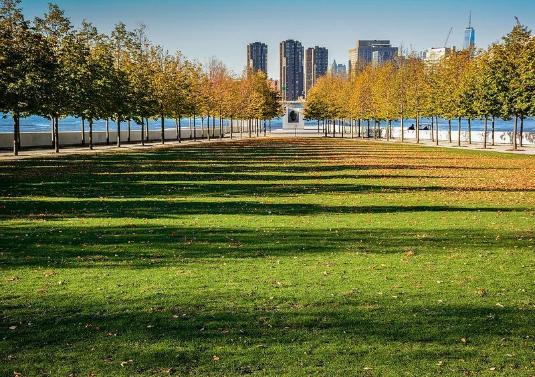
The Four Freedoms as articulated by Roosevelt are inspiration for educational art and dedicated public spaces. Eponymous artworks by Norman Rockwell were published with related essays in The Saturday Evening Post in February and March, 1943. Distributed as prints and posters, his illustrations raised over 132 million dollars, then applied toward the war effort through the purchase of war bonds. In praise of the Four Freedom's Park, a memorial to FDR on Roosevelt Island in New York City, here is an excerpt of a poetic adaption from Bloomberg's critic James Russell:
"Subtle and dignified homage to the president,
Bookended by sloping granite slabs,
it rises just 12 feet to the top of a massive berm,
it evokes Romantic Classicism of the French Enlightenment.
A tidy downward-sloping lawn,
Symmetrically lined by linden trees,
Delicately screen the city views.
A bust depicting a serene Roosevelt,
Floats within a granite niche.
A roofless room,
evoking an unfinished classical temple.
The high sides leave you in a calm, austere space,
frames the sky overhead
and the swirling river waters winding their way to the sea."
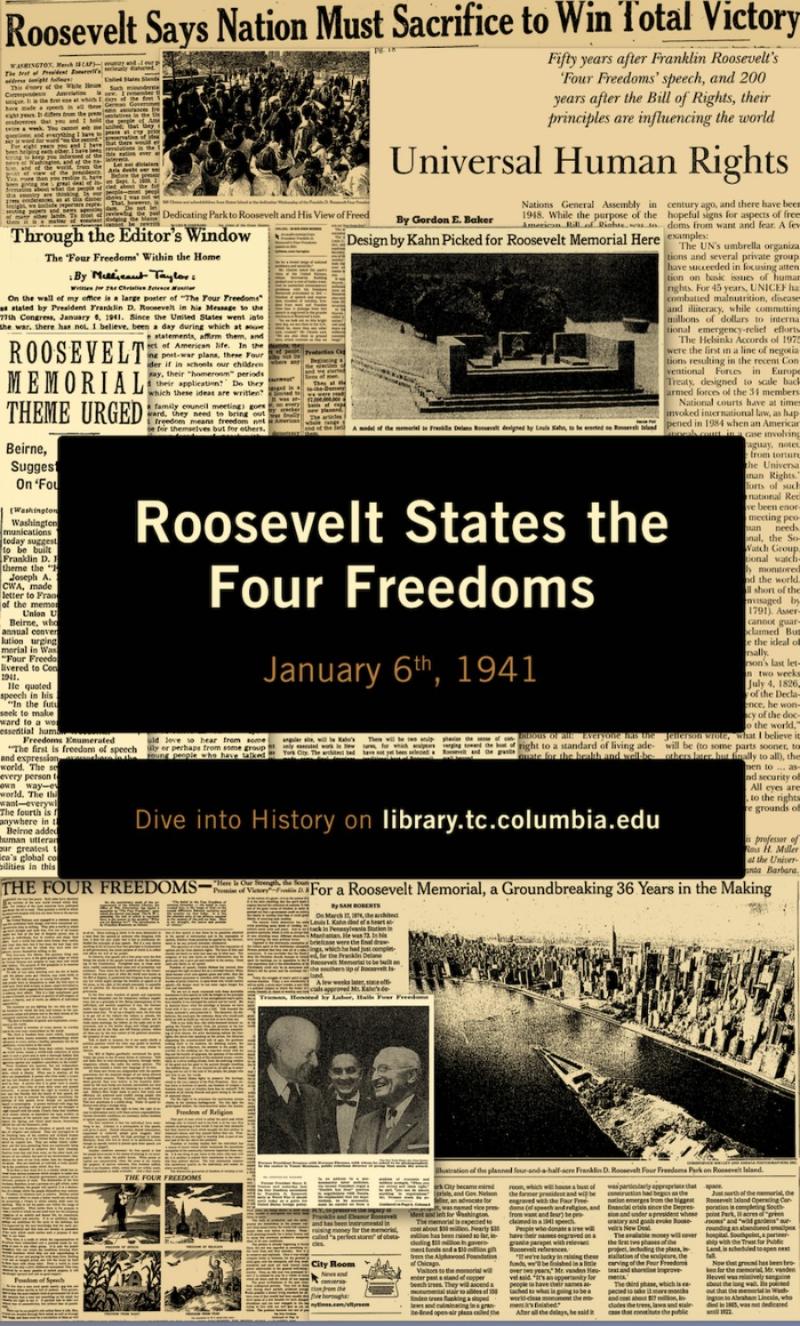
The following articles are drawn from Proquest Historical Newspapers, which informs and inspires classroom teaching and learning.
- Roosevelt Says Nation Must Sacrifice To Win Total Victory: Business As Usual, Normalcy To Vanish--U. S. Dedicated To 'Four Freedoms' Aim. (1941, Mar 16). Daily Boston Globe (1928-1960)
- Roosevelt's "Four Freedoms". (1941, Aug 15). The Manchester Guardian (1901-1959)
- Taylor, M. (1942, May 12). Through the Editor's Window the 'Four Freedoms' Within the Home. The Christian Science Monitor (1908-)
- Franklin, R. (1942, Aug 13). The Four Freedoms: "Here Is Our Strength, the Source and Promise Of Victory". Daily Boston Globe (1928-1960)
- Dales, D. (1959, Dec 06). Truman, Honored By Labor, Hails Four Freedoms: Truman Hails Four Freedoms In Getting Labor Unit's Award. New York Times (1923-)
- Roosevelt Memorial Theme Urged: Beirne, Union Head Suggests It Be Based On 'Four Freedoms'. (1960, Apr 15). The Sun (1837-)
- Goldberger, P. (1974, Apr 25). Design By Kahn Picked For Roosevelt Memorial Here. New York Times (1923-)
- Baker, G. E., & Miller, R. H. (1991, Feb 12). Universal Human Rights: Fifty Years After Franklin Roosevelt's 'Four Freedoms' Speech, and 200 Years After the Bill Of Rights, Their Principles Are Influencing the World. The Christian Science Monitor (1908-)
- Roberts, S. (2010, Apr 15). For a Roosevelt Memorial, a Groundbreaking 36 Years In the Making. New York Times (1923-)
- Foderaro, L. W. (2012, Oct 18). Dedicating Park To Roosevelt and His View Of Freedom. New York Times (1923-)
Tips:
- Fischer, David Hackett. Liberty and Freedom. Oxford: Oxford University Press, 2005. e-book
- Four Freedoms Curriculum Hub. Franklin D. Roosevelt Presidential Library and Museum. Provides historic context, central issue, key questions, primary sources, classroom activities, links for more information, and distance learning opportunities.
- Howard, Thomas C., and William D. Pederson. Franklin D. Roosevelt and the Formation of the Modern World. London: Routledge, 2015. e-book
- Morsink, Johannes. The Universal Declaration of Human Rights Origins, Drafting, and Intent. Philadelphia: University of Pennsylvania Press, 1999. e-book
- Roosevelt, Franklin Delano. “Four Human Freedoms.” Human Rights Quarterly 6.3 (1984): 384–385. excerpt from the Address of the President
- Wallenfeldt, Jeffrey H. A New World Power America from 1920 to 1945. 1st ed. New York: Britannica Educational Pub. in association with Rosen Educational Services, 2013. e-book
Images:
- FDR Memorial Wall, Courtesy of Wikimedia Commons
- Special News Slide, Courtesy of the Gottesman Libraries
- Franklin D. Roosevelt Four Freedoms Park, Courtesy of Wikimedia Commons
***
Need to keep current, look to the past, teach a topic? The Everett Cafe features daily postings of news from around the world, and also promotes awareness of historical events from an educational context. Be sure to check the news postings on Learning at the Library, where you can delve into history.