Remembering Mabel Carney: A Glimpse into the Teachers College Archives
In Record Group 6: Office of the President, in the papers of Dean James Earl Russell and President William F. Russell, are six folders containing correspondence with Mabel Carney, Head of the Department of Rural Education from 1919 to 1941. These correspondences, alongside proposals, memoranda, and programs for lectures and conferences, provide a snapshot of Mabel Carney’s time at Teachers College, and illuminate her efforts to support the field of rural education as well as her interest in Black education.
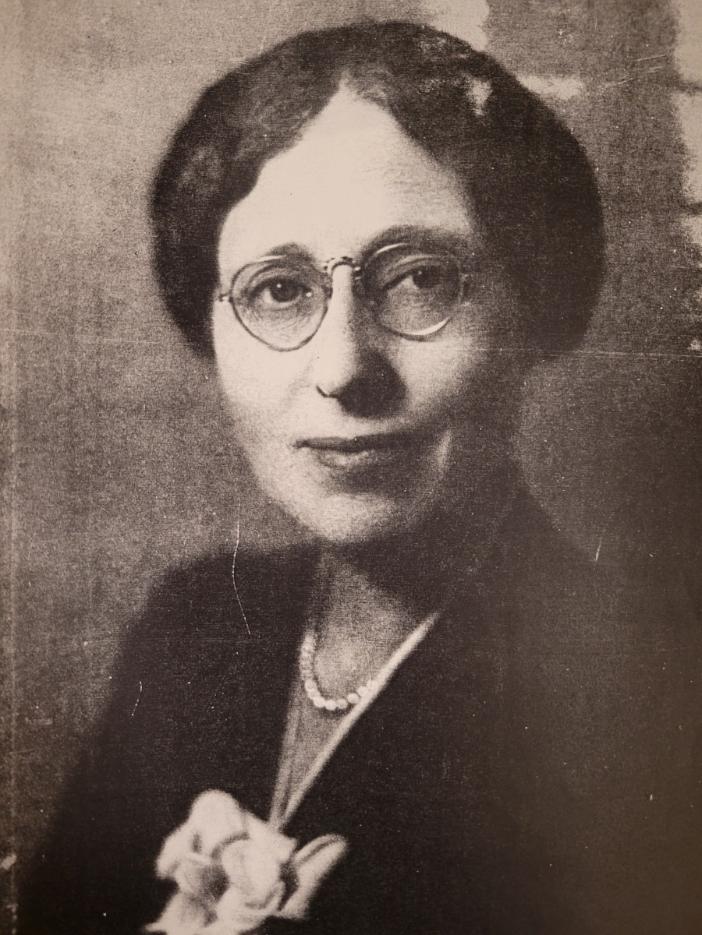
Photograph of Mabel Carney from the "P" Collection. (P1007)
Mabel Carney came to Teachers College at the conclusion of the first World War, serving as a part-time junior faculty member in 1917 while earning her Master’s degree. When she completed her MA in 1919, she was awarded full-professor status, becoming Head of the Department of Rural Education. A progressive educator, Carney solidified her expertise in the field of rural education with the publication of Country Life and the Country School (1912) as well as her thesis Preparation of Rural Teachers in High Schools (1919). During her tenure, Carney was active and influential. She embarked on countless research trips to the Midwest, to the South, as well as to England and Africa; she championed the work of other women educators, such as Fannie Dunn; she served as the first woman president of the Department of Rural Education at the National Education Association; she mentored dozens of students and colleagues; and she inaugurated the first courses on African American Education at Teachers College [1].
The few articles written about Carney’s life highlight her contributions to the field of Rural Education as being grounded in mentorship. Kathleen Weiler, Professor of Education at Tufts University, notes:
“Carney provided nurturance and caring for both students and colleagues, to the detriment of conventional markers of academic achievement such as books and articles. As a result, compared with the academic ‘stars’ of Teachers College in the 1920s and 1930s, Carney was and remains relatively unknown.” (2005, p. 2603)
Additionally, Richard Glotzer, a senior lecturer in the School of Social Work at the University of Akron, observes that Carney was a mentor to “large numbers of black students” whom “she guided through masters and doctoral work” (1996, p. 332). This mentorship is evidenced in William F. Russell’s papers. In a copy of the February 1942 Advanced School Digest, Carney discusses studies and projects produced by doctoral students at Teachers College. Among said projects, Carney advised the following: Jane Ellen McAllister’s The training of Negro teachers in Louisiana (1929), Felton Grandison Clark’s The Control of State-Supported Teacher-Training Programs for Negroes (1934); William Riley Davis’s The Development and Present Status of Negro Education in East Texas (1934); Dwight Oliver Wendell Holmes’s The Evolution of the Negro College (1934); George N. Redd’s A Suggested Plan for the Education of Rural Teachers in a Small Liberal Arts College (1939); Edna Meade Colson’s An Analysis of the Specific References to Negroes in Selected Curricula for the Education of Teachers (1940); and George William Gore, Jr.’s In-service Professional Improvement of Negro Public school Teachers in Tennessee (1940) [2]. Jane Ellen McAllister was the first Black woman to ever receive a doctorate at Teachers College, and according to Mabel Carney, McAllister was the first Black woman to receive a doctorate in Education at any institution [3].
These projects, and the examination of Black Education at Teachers College, were possible, in part, due to Carney’s own interest in the topic. In the early 1920s, she began to study the way education was designed, structured, and implemented for African Americans, particularly in rural communities in the American South [4]. Her initial interest culminated in the organization of educational programming and lecture series to take place at Teachers College. A November 22, 1922 letter from Mabel Carney to James Earl Russell reveals Carney’s plan to institute a “special program on Negro Education” to take place in the Horace Mann Auditorium [5]. When the program ran on December 14th of that same year, it included a performance by the Hampton Quartet; addresses by Thomas Jesse Jones of the Phelps-Stokes Fund and William Pickens, field secretary for the NAACP; and a demonstration of “Native African life” by Teachers College student C. Kamba Simango and his wife [6]. Over the next several years, Carney was instrumental in organizing further conferences and lectures, with lectures on “Interracial Cooperation” taking place in the summer of 1929 and lectures on “Negro Education and Race Relations” taking place in the spring of 1930 [7].
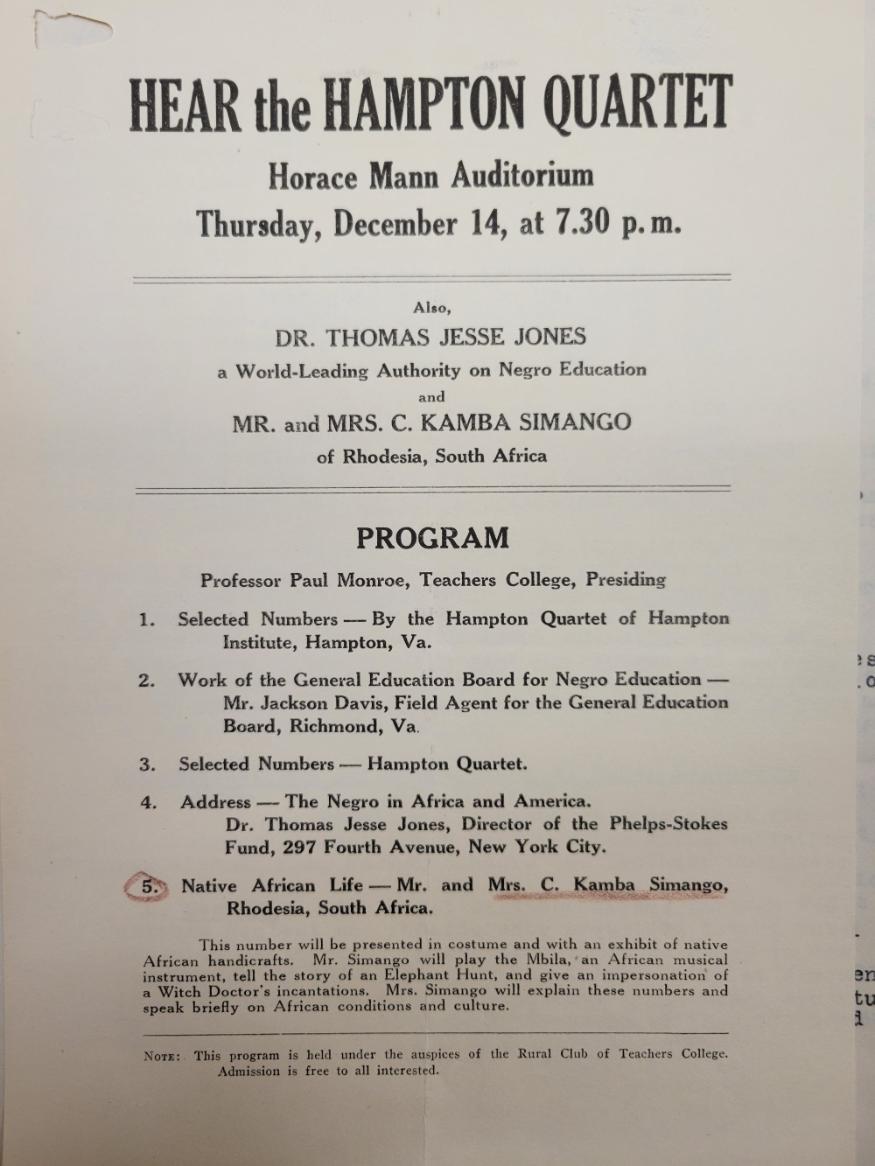
Program from "Hear the Hampton Quartet," December 14, 1922.
In addition to these lecture series, Carney worked towards implementing a course on Black Education within the Rural Education Department [8]. Of such a course, Carney wrote: “My thought is that this course should be a regular Unit of five two-hour lectures offered by outstanding leaders in the field of Negro Education” [9]. However, she expressly noted that in its first year, the lectures should be conducted by “white persons” [10]. As Kathleen Weiler notes, “[Carney’s] choice of speakers … shows her close connection with Northern philanthropists” (2005, p. 2607). The first “Negro Unit Course” at Teachers College was instituted in 1925 and the course was designed to examine the historical and current state of Black education in the United States, as well as the influence of philanthropic agencies [11]. Mabel Carney’s sabbatical in 1926, during which she traveled to South Africa, delayed further developments for the unit course until 1928 and 1929 [12]. Student evaluations from the spring of 1929 reveal the general consensus about the course: it was eye-opening and inspiring for white students [13]. 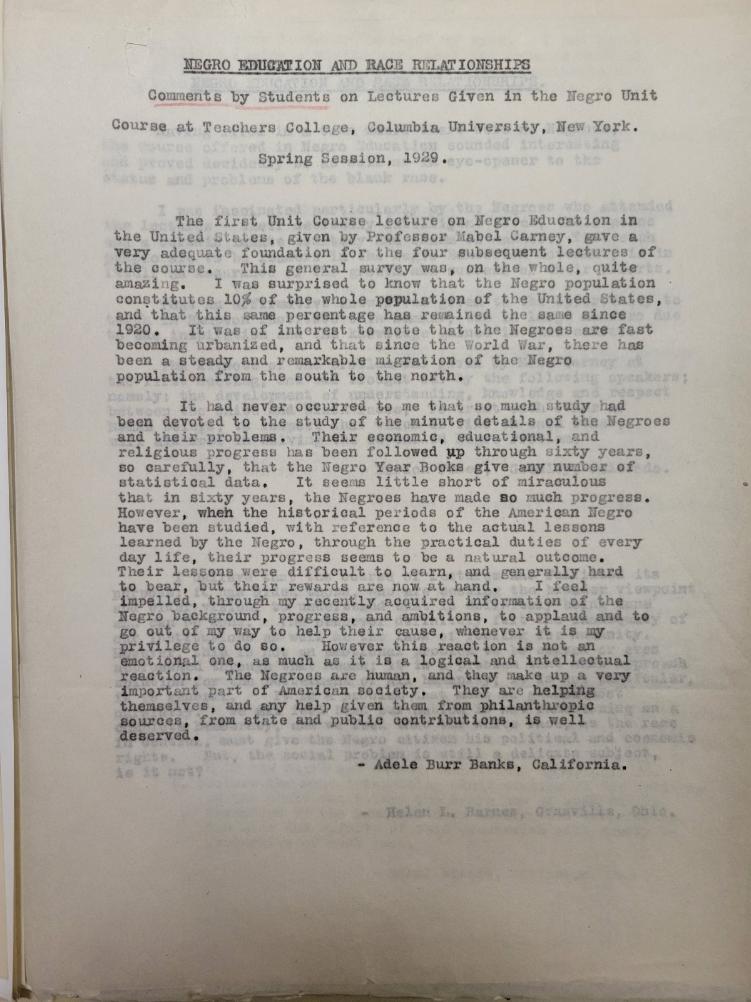
A positive student evaluation for Mabel Carney's unit course.
Carney continued to work towards supporting the teaching and study of rural education and Black education at Teachers College until her retirement in 1941. Post-retirement, Carney still remained active in the field, visiting segregated schools and connecting with Jeanes Teachers of the Jeannes Foundation [14]. She was awarded an honorary Doctorate from Howard University in 1942, in connection with her work to support Black education. Carney continued to write newsletters to colleagues and friends throughout the 1940s, keeping them abreast of her life and her work. In February of 1969, at the age of 84, Mabel Carney passed away.
The archive retains traces of Carney’s memory and legacy, illuminating her work while also obscuring a more detailed understanding of the woman she was. Carney undoubtedly contributed much to the development of the field of education, but her contributions have not been fully understood.
Notable Mabel Carney Documents in the Teachers College Archives
RG 6: James Earl Russell Papers, Series 4: Correspondence with the Faculty
Box 11, Folder 184A: Carney, Mabel (1918-1928)
- Correspondence from Mabel Carney to James Earl Russell concerning Carney's South Africa Trip (September 1926)
- Letter concerning Carney's travels in England (February 24, 1926)
- Letter to James Earl Russell concerning improvements to the One-room school (October 27, 1924)
- Correspondence concerning the Women's Faculty Club (1922)
- Documents concerning the preparation of rural teachers (undated)
- Document "Why Differentiate in Rural Education?" (undated)
- Documents concerning rural education and Teachers College departments (1927)
- Correspondence concerning Carney's time in South Africa
- Itinerary for Carney's South Africa trip
- African Letters (A printed journal of Carney’s letters to students, colleagues, and friends concerning her trip to Africa in 1926)
Folder 184B: Carney, Mabel (1918-1928)
- Correspondence between Mabel Carney and James Earl Russell concerning a proposal suggesting a study of developments in Rural Education (1914)
- A memorandum on rural education (1922)
- A program "Department of Rural Education: National Education Association" (February 27-March 2, 1922)
- Correspondence between Carney and Russell concerning rural education research and funding (1922)
- Program for "Hear the Hampton Quartet"
- Correspondence concerning Carney's upcoming conferences and talks and potential courses on "Negro Education" (1920, 1922-1923)
- "Statement Concerning the National Re-Organization of Education as an Outgrowth of the War" (1919) and associated correspondence
Box 12, Folder 186: Carney, Mabel
- Correspondence concerning the "Country Project" (1929)
- Proposal "County Demonstration in Rural Education Services" (1929)
- Conference Plans (1929)
Box 12, Folder 187: Carney, Mabel
- Program for Lectures on Negro Education and Race Relations (April 28, 1930)
- Correspondence concerned with the use of Rosenwald fund for the expenses of Inter Racial Committee at Teachers College (1929)
- Correspondence concerned with the use of funds for the "Negro Lecture series" (1930)
- "Negro Education and Race Relations" – Comments by students on Lectures Given in the "Negro Unit Course at Teachers College" (1929), includes outline of course units
- "Constitution of the Negro Education Club of Teachers College" (undated)
- Correspondence concerning materials for an exhibit on "Negro Education and Race Relations Activities" (1928-1929)
- Program for "Interracial Cooperation: Special Meeting of Colored and White Students Interested in Race Relations in the United States" (1927)
- "Interracial Meeting - Summer Session 1929"
- A list of prospective speakers for "Negro Unit Courses" (undated)
- Correspondence concerning admissions and scholarships (1930)
- Course outlines and study proposals for "Rural Education" (1921 and 1929)
- Correspondence concerning lectures on race relations (1930)
- Letter to Edwin R. Embree concerning funding for a conference on race relations (1929)
Box 71, Oversize, Folder 158-263
- Program "Conference on Africa (October 30-November 1, 1925)
- Program "Dinner in the Interest of Country Life" (1928)
- Program "Symposium on Race Relations in the United States" (August 6, 1929)
- Program "Lectures on Negro Education and Race Relations" (April 28, 1930)
William F. Russell Papers
Box 3, Folder: Mabel Carney 1 of 1
- Letter from Mabel Carney to students and colleagues concerning her life after retiring from Teachers College; highlights her professional activities in the field of rural education and African American education in the United States (March 22, 1943)
- Correspondence between William F. Russell and M. C. Langford concerning Mabel Carney’s professional interests and credentials (March 1945)
Box 3, Folder : Mabel Carney 2 of 2
- Mabel Carney's Report to William F. Russell, "Negro Education and Race Relations" (1942)
- Tentative and Proposed Program of Activities, September 14-August 31, 1942-43. This is a program of research and professional activities.
- A reserve list for Teachers College Library resources for Carney's course "Education s245D - Special Problems in the Education of Negros in the United States" (1940)
- A New York Times article by Dr. John Finley "On the Use of the Capital N in the word Negro" (March 7, 1930)
- Document outlining "Faculty of Teachers College Who Have Some Special Interest in Negro Life and Student Welfare" (undated)
- A list from Mabel Carney of "Negro Leaders Recommended as Consultants and Lecturers" to work with Teachers College Faculty (August 14, 1942)
- List from Mabel Carney "Possible Professorial Material Among Negro Educators" (August 14, 1942)
- The Advanced School Digest, "Doctoral Dissertations and Projects Relating to the Education of Negroes" by Mabel Carney (February 1942)
- Pamphlets and programs concerning lectures on "Negro Education" and "Race Relations” (1932, 1933, 1935, and 1936)
- Commemorative Program on James Weldon Johnson (1938)
- Program: "Tenth Anniversary Celebration of the Negro Education Club" (1938)
- Sheet from summer session booklet "Courses for directors of Adult Education" (undated)
- Copy of Mabel Carney's letter to R.J. Leonard (December 13, 1924)
- Correspondence concerning Carney's request for Sabbatical
Other Archival Resources
- See also "Carnegie Corporation -- 1932 --" and “Committee on Racial Relations” in William F. Russell Papers
- See also “Negro Education and Race Relations” in TCANA Vertical Files (Box 10)
- Mabel Carney’s correspondence can be found at the Hartford Seminary Archives
- The Rockefeller Archive Center also houses records related to Mabel Carney
Other Resources Concerning Mabel Carney
- “The Career of Mabel Carney: The Study of Race and Rural Development in the United States and South Africa” by Richard Glotzer
- Weiler, K. (2005). Mabel Carney at Teachers College: From Home Missionary to White Ally. Teachers College Record (1970), 107(12), 2599–2633. https://doi.org/10.1111/j.1467-9620.2005.00630.x
- “Black Women at Columbia University before Brown v. Board” by Hettie Williams
References
[1] See Weiler, K. (2005). Mabel Carney at Teachers College: From Home Missionary to White Ally. Teachers College Record (1970), 107(12), 2599–2633; Mabel Carney to Dean James Russell, March 26, 1917. Box 11, Folder 184B, James Earl Russell Papers, Gottesman Libraries, Teachers College, Columbia University; “Negro Education – Unit Course 146A” February 1929. Box 12, Folder 187, James Earl Russell Papers.
[2] “Doctoral Dissertations and Projects Relating to the Education of Negroes,” The Advanced School Digest, Vol. VII, no. 3, February 1942. Box 3, folder “Carney, Mabel 2 of 2, ”William F. Russell Papers.
[3] Ibid.
[4] Kathleen Weiler provides an excellent account of the social, cultural, and political milieu in which Carney’s interest develops. See pages 2604-2606 of her 2005 article “Mabel Carney at Teachers College: From Home Missionary to White Ally”.
[5] Mabel Carney to Dean James Russell, March 26, 1917. Box 11, Folder 184B, James Earl Russell Papers, Gottesman Libraries, Teachers College, Columbia University.
[6] Program “Hear the Hampton Quartet”, Box 11, Folder 184B, James Earl Russell Papers, Gottesman Libraries, Teachers College, Columbia University.
[7] Box 12, Folder 187, James Earl Russell Papers, Gottesman Libraries, Teachers College, Columbia University.
[8] December 13, 1924 letter to R. J. Leonard from Mabel Carney, Box 11, Folder 184A, James Earl Russell Papers, Gottesman Libraries, Teachers College, Columbia University.
[9] Ibid.
[10] Ibid.
[11] “Negro Education – Unit Course 146A” February 1929. Box 12, Folder 187, James Earl Russell Papers,Gottesman Libraries, Teachers College, Columbia University.
[12] For more on Mabel Carney’s South African trip, see Carney’s African Letters (1926) and other correspondences on her trip in Box 11, Folder 184A, James Earl Russell Papers, Gottesman Libraries, Teachers College, Columbia University.
[13] Student evaluations on “Negro Education and Race Relations,” Spring 1929. Box 12, Folder 187, James Earl Russell Papers,Gottesman Libraries, Teachers College, Columbia University.
[14] Correspondence from Mabel Carney, March 22, 1943, Box 3, Folder “Mabel Carney 1 of 2”, William F. Russell Papers, Gottesman Libraries, Teachers College, Columbia University.