Today In History: Black Thursday at the New York Stock Exchange
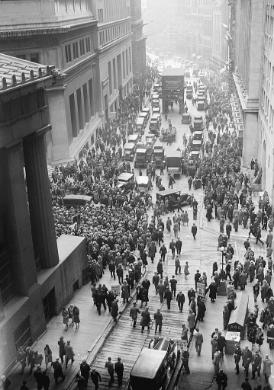
"Word quickly spread on this crisp fall morning: Stocks were in big trouble. The boys selling the morning newspapers shouted the news. Serious-voiced announcers on the radio commented on it. On the street, everyone was talking about it. Something was terribly wrong with the stock markt, the greatest fountain of wealth in the history of America.
In the financial district of New York City and in other offices where brokers sold stocks, people began to gather well before trading formally began at 10 A.M. Men and women, nervous and pale, rushed to grab seats in the special customers' rooms at brokerage houses all around Wall Street. One observer said they looked like 'dying men counting down their own last pulse beats.' "
--Karen Blumenthal, Six Days in October
On October 24th, 1929, 12.9 million shares of stocks were traded, with an unanticipated decline of prices and an 11% decrease in their market value. Panic and chaos ensued on the trading floor of the New York Stock Exchange, affecting thousands of investors. Widespread speculation, regulations on credit from the Federal Reserve, rising debts, and economic recession are among the factors contributing to the collapse that led into the Great Depression. Proven was the fragility of the economy, aggravated by weaknesses in the banking system and unregulated financial markets.
The second largest stock market crash occurred on October 29th, 1987 -- known as "Black Monday" when the Dow Jones Industrial average dropped by roughly 22.6% in one day; over 604 million shares were traded, causing the New York Stock Exchange to lose more than $500 billion in market capitalization. Financial and investment firms bore significant layoffs, some companies went public, and the technology industry was seen to drive volatility, especially because of computerized trading.
While secondary school curriculums may tackle financial literacy, understanding the actual volatility of the stock market is often through experience in trading, unless schools have highly specialized programs that introduce students to investment in dedicated or endowment funds. University or college degrees in finance, business, or economics provide insight into the market, portfolios, and financial management, and may incorporate hands-on courses in collaboration with select advisory firms.
The following articles are drawn from Proquest Historical Newspapers, which informs and inspires classroom teaching and learning.
- Smith, R. (1939, Oct 22). 10th Year Since '29 CrashFinds Market on Rise: Famous 'Black Thursday' Split Armistice Period Between Old, New Wars: Street Peers at Future. The Atlanta Constitution (1881-1945)
- Gardner, F. (1939, Oct 24). Recall 10 Years Ago Today? Dabblers in Market Do as Grim 'Black Thursday'. The Austin Statesman (1921-1973)
- Black Thursday Panic Recalled. (1958, Oct 25). The Washington Post and Times Herald (1954-1959)
- Mahony, J. (1974, Oct 20). Black Thursday--the Stock Market's Darkest Day. Boston Globe (1960-)
- Martin, J. (1975, Jan 05). Crisis of Abundance and 'Black Thursday'. Boston Globe (1960-)
- DiHacco, T. V. (1981, Oct 18). The Crash of '29: Myths and Realities. The Sun (1837-)
- Sobel, R. (1985, Oct 20). Money Monitor: The Black Days of 1929 Leave Lesson, Legacy. Newsday (1940-)
- Beam, A(1987, Oct 20). 1929 Again? Experts Assess the Parallels. Boston Globe (1960-)
- Two Views on Black Thursday, '97: Global Viewpoint Perspectives on the Emerging world Community. (1997, Nov 12). The Times of India (1861-)
- Lipin, S. (2000, Jan 18). Done That? Flashback to '60s Echoes 'New Paradigm' Talk. Wall Street Journal (1923-)
Tips:
- Beaudreau, Bernard C. , ed.The Stock Market Boom and Crash of 1929 Was Not a Bubble : A Book of Readings. Cambridge Scholars Publishing, 2019. e-book.
- Bierman, Harold. Beating the Bear : Lessons from the 1929 Crash Applied to Today’s World. 1st ed., Praeger, 2010. e-book.
- Blumenthal, Karen. Six Days in October : The Stock Market Crash of 1929. First edition., Atheneum Books for Young Readers, 2002. Curriculum ; HB3717 1929 .B58 2002.
- Dubois, Muriel. The Great Depression in America. Jackdaw Pub., 2003. Curriculum ; HB3717 1929 .G67 2003.
- Klein, Maury. Rainbow’s End : The Crash of 1929. 1st ed., Oxford University Press, 2003. e-book.
- Spears, Rebecca A. Stock Market Crash of 1929. Jackdaw Publications, 2006. Curriculum ; HB3717 1929 .S76 2006.
Images:
- Crowd Outside New York Stock Exchange After the Crash of 1929, Wikimedia Commons.
- New York Stock Exchange, Canva.
Need to keep current, look to the past, teach a topic? The Everett Cafe features daily postings of news from around the world, and also promotes awareness of historical events from an educational context. Be sure to check additional Cafe News postings on the library blog.