Operations and Web Services: Summer 2025 Report
Part-time Interim Reappointments and New Hires
Hiring managers were informed of the current active hiring freeze for all College staff positions, with the exception of internal student workers. Therefore, all Library departments (Reference and Reader Services, Technical Services, Special Collections, and Design), could only hire and extend appointments for TC students as Library Associates moving forward. Librarians assisted all departments by submitting necessary Presidential-approved justifications to extend appointments via ePAFs for existing external student workers, and coordinated with HR, Student Employment and Budget offices to post requisitions for internal student workers only. This resulted in another successful Summer of multiple new hires for all departments, including a newly approved second Special Collections student worker. Now, all Library Associates have necessary appointments through Winter Intersession and FY 26.
Myers Award
With two selected Myers awardees for Fall 2025 exhibitions, both artists signed OGC approved agreement contracts for timelines, supplies and commission payments. We coordinated with both to ensure contracted budget and materials ordering and pick-up. As we noticed with last year’s awardee, ceramics items often have very expensive freight/packaging charges and take weeks to ship. We will keep this in mind for future applicants expressing project interest in ceramic works to best support artist and Library operations.
Printing
With continued access issues since TC’s PrinterLogic implementation in Fall 2024, the Library explored additional printing options available around campus, including PawPrint color printing. We met with CUIT to map and price out possibilities for extending PawPrint’s services to include color printing, per patron needs that are currently only available through a flawed PrinterLogic platform. After receiving an initial quote to replace one b&w printer to color on the first floor, where printing is most active, we decided to assess patron color printing needs to justify increased annual and one-time installment fees. We will reconnect with CUIT to confirm any next steps after Fall 2025 add/drop. In the meantime, we are still actively in touch with TCIT via walkthroughs, tickets and email for all PrinterLogic inquiries, including student accessibility issues, staff printer misuse, and printer guide instructions.
Summer Staff Outing
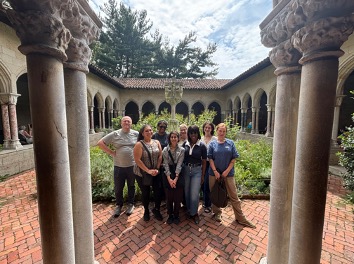
Library staff completed our second annual summer outing, focusing on professional development initiatives and a day to thank everyone for their continued contributions to our valued patrons and facilities. This year, we catered breakfast and participated in a guided gallery and garden tour at the Met Cloisters. All on-site Library staff were invited to enjoy Dunkin breakfast, provided by extra gift cards from our recent satisfaction survey. Then, eight FT/PT/Union staff members traveled uptown on the bus for a fun-filled day away. Our tour guide, Jean, was one of the best educators we’ve had the pleasure of spending time with, as we were whisked through medieval history through beautiful surrounding fauna, art and architecture. Here is our staff picture below to commemorate the wonderful day spent together!
LibAnswers
As the Spring semester came to a close, the Library’s adoption of LibAnswers as a replacement for FreshDesk became official. Operations and Web Services Team members played a crucial role in this transition, as they were responsible for contracts, system configuration, and service design.
Configuring LibAnswers required us to balance the needs of patrons as they’ve come to expect our services while also compensating for the natural learning curve of operating the back end of a new web product. Fortunately, because of the ubiquity of Springshare products in Library spaces, we were able to capitalize on a few staff members’ previous experiences with the platform. Indeed, one member of the Operations and Web Services team knew the product intimately, having configured it once before in another library.
Inputs
One of the key components of the configuration involved ensuring that we could account for each generic library email address under our purview and appropriately redesignate their handling to the new system. This ultimately required a good deal of testing within LibAnswers, our designated email accounts, and our previous reference management system – within which we temporarily built an autoforwarding routine to allow for tickets to appear in both systems. We also needed to analyze our then-current “Ask a Librarian” portal and ensure that the data points supplied by patrons match current expectations, and then recreate that portal in a new space. We opted to mostly maintain the functions of the previous portal, but removed the “type” designation from the form, finding that patrons often aren’t sure how exactly to use this data point, and that its output isn’t statistically significant. Later on, we also decided as a group to add a “status” designation for patrons to supply when filling the form out. Finally, we were able to greatly improve upon the look and feel of the portal, which is fully embeddable as a Springshare widget:
In addition to the new interface for patron tickets, the Team also configured LibChat: a live, chat-like product where patrons can interface with Library staff for on-the-spot answers to their questions. The product has proved meaningful to a curious community, as it’s already given life to nearly a hundred separate conversations as of this writing.
Outputs
Additionally, the Operations and Web Services Team had to carve out times to meet with the Library’s other teams: Technical Services, Special and Digital Collections, and Reference and Reader Services. It was in those meetings that we weighed concerns and fielded ideas about the configuration that would best meet the pre-existing needs of each individual. Indeed, we found that the feedback received from these groups played a critical role in shaping how the services in LibAnswers would speak to both public demand and internal management. The Operations and Web Services Team also furnished a document with which other Librarians could ask publicly-facing questions and receive answers, which was also important to the development of the configuration.
Finally, we used the migration to LibAnswers as an opportunity to rethink the meaning of a reference platform for the Library. In this, we arrived at an understanding that LibAnswers could serve as a true “knowledge base” for the library by allowing the questions that we normally record at the services desk into our broader analytical output to get a fuller portrait of the library’s value to the community. Looking ahead, we anticipate being able to leverage LibAnswers’ “Frequently Asked Questions” space to create more value for a community hungry for information. As part of this, the Operations and Web Services team continues to work with Springshare support to build an archive of tickets from our previous system with which we could hopefully derive more frequently asked questions.
Renewals Research
Summer in the library began uncharacteristically with a loan renewals-related problem. Our library associates noted that at the end of May there was an uptick in patrons reporting an inability to renew their loans. This was confirmed by similar reports in the library’s ticketing system.
Typical loan behavior for regular circulating collections should allow for patrons to borrow a title until one of three fixed return dates set by the library system’s internal calendar. Those dates are known colloquially as “End of Spring”, which usually falls near the end of May, “End of Summer”, falling near the beginning of October, and “End of Fall”, falling in Mid-February. As that date approaches, the system automatically sends out courtesy notices to patrons letting them know their loans are due back soon. At that point, many of our patrons choose to renew their loans via a button that can be accessed in their account view in the catalog. Once renewed, the terms of a patron’s loan is extended to six months from their original borrowing date. This wasn’t happening, and the error message patrons were seeing suggested that the maximum dates for their loans had already been reached.
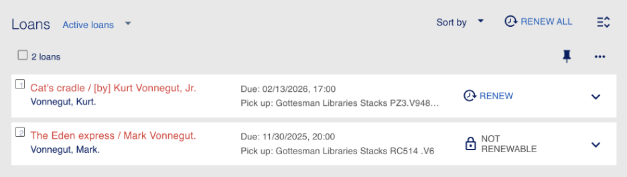
After an extended period of support from Ex Libris, we found that the issue patrons were experiencing most likely laid in a delay in setting due dates for the summer period, whereupon courtesy notices were going out to patrons before the new date had been programmed into the system. Because of this error, there was no way for the system to “see” beyond the end of Spring, which at that point was less than a week from arriving, and which disallowed patrons to extend the term of their loans to the six months guaranteed to them. Because of our research, the team feels much more prepared to handle loans- and renewals-related issues in the future, including routine due date changes.