Transatlantic Influence on Colonial American Education

Cotton Mather
At the center of this narrative stands Cotton Mather’s 1719 sermon. The manuscript was gifted by Mrs. Peter M. Bryson in 1887 as a memorial to her late husband—and TC founder— Peter Bryson. The slim volume leads with an inspirational from Job 23:12 (King James Version)”
…esteemed ye words of His mouth more than my necessary food
As an object, the sermon is its own testament to the process of Mather’s continuous leadership at Old North Church in the late 17th and early 18th century. His reference to Job in this—and other sermons—can also be loosely connected to his work advocating for smallpox inoculation. This bridge between theology and science influenced the early curriculum of institutions like Yale and Harvard.
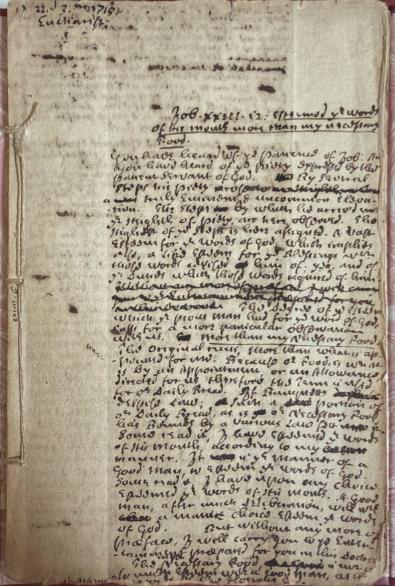
1st page of Cotton Mather's Sermon, 1719—Teachers College, Gottesman Libraries
While popularly remembered for his involvement in the Salem Witchcraft trials (detailed in his 1693 work, The Wonders of the Invisible World), Mather was far from the myth of "witch-hunting" puritan as exemplified in his 1708 sermon Corderius Americanus. In the sermon, fully titled A Discourse on the Good Education of Children, Mather eulogized his own teacher, Ezekiel Cheever, signaling a shift in early American education toward a structured, classical, yet morally rigorous pedagogy.
The eulogy focuses on the imperative to begin teaching children from the earliest age possible, and, while there is no doubt in the pedagogical content centering ecclesiastical material and cosmology, the interesting part is the establishment of the structure of learning itself. Mather’s lays out a specifically structured plan to “[t]ruly as much as ever we can help them to; all they can remember—all they can comprehend.”[1]This comprehension should include the following four tenets of learning: understanding the history of the scriptures, the principles of the scriptures, the commandments of the scriptures, and the children should learn to read “as early as possible”.[2]
Perhaps the most significant, perhaps understated, influence on Early Colonial schooling is the relationship between Cotton Mather and the German Pietist August Hermann Francke. Through extensive correspondence, Mather and Francke forged an ecumenical bond that linked Boston to Halle, Germany.
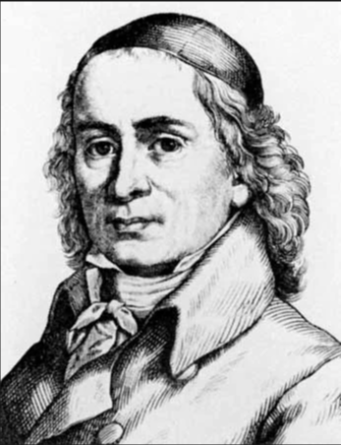
Augustus Hermann Francke
Francke’s Pedagogical Writings (A.H. Francke's Pädagogische Schriften : Nebst der Darstellung seines Lebens und seiner Stiftungen) and his work at the Waisenhaus (Orphanage) in Halle served as a blueprint for Mather. It was in these correspondences that Mather explored the concept of "Ragged Schools"—charity schools designed to educate the most destitute children.
The cross-pollination and acceptance of New England Puritans by German Pietists, and vice-a-versa, led to a strong relationship that went beyond the lines of the religious and spiritual beliefs, but extended into involvement in pedagogical practices as understood in the new spiritual landscape of the post-Reformation sermon and spiritual claims. The German Pietist movement, equally influenced by the revolution of reformers like Luther, Calvin, and various clergy of Scottish pedigree, recognized the New England church movement and new covenant as a reaction against “the general decline and corruption of both the Roman church and the established churches of the. Reformation”.[3]
In 1715, Mather penned Nuncia Bona e Terra Longinqua: A Brief Account of some Good & Great Things: A Doing for the Kingdon of God in the Midst of Europe: Communicated in a Letter to August Hermann Franke. In typical rhetorical form, Mather pays Francke a number of compliments regarding his piety, station in life, devotion to service of fellow man, and his dedication of funds towards the establishment of a
[c]apacious Orphan-House, wherein he has now lodg’d fed, and cloathed a Multitude of Poor Children; and by Tutors flaming with Excellent Piety, bestowed Religious Education upon them, till they are sent forth to proper Employments, or the riper Witts among them set a part for the University[4]
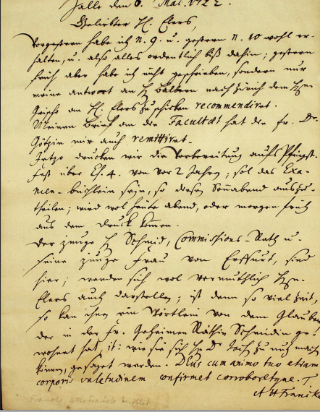
Francke established The Francke Foundations and the "School Town" in 1695, establishing not only one of the first Bible Institute’s in Europe at Halle, but also structured one of the first teaching as profession programs, The Francke Foundations in Halle introduced several revolutionary concepts that crossed the Atlantic. Included among these pedagogical practices and institutions was the idea of Universal Education of children, regardless of class; The Realschule Model: move toward "real" or practical education—natural sciences, geometry, and manual skills—rather than just Latin and Greek; and the establishment of the Pedagogium, one of the first formal models for teacher seminars.
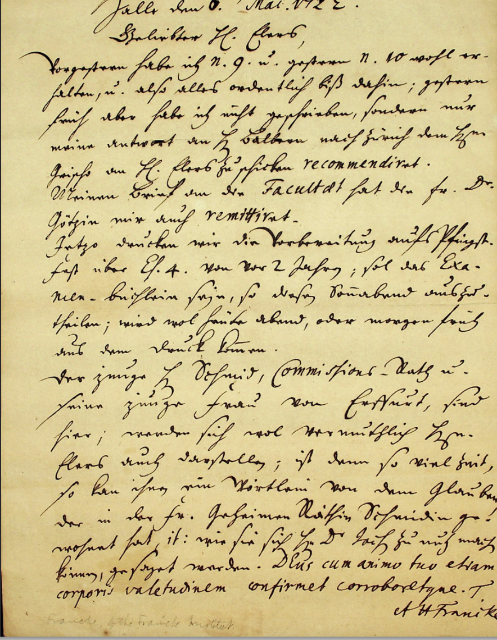
Francke Manuscript, 1722, Teachers College, Gottesman Libraries
By the 19th century, the religious impulse for "practical education" evolved into specialized pedagogical movements often influenced by the burgeoning intellectual movement of Transcendentalism. Born from a split within the Unitarian Church (which in turn had come from a split with the New England Congregationalists), the Transcendentalists rejected the Calvinist notion of predestination and desired a more individual relationship with their respective spiritual destination. A notable and founding figure of the movement was Elizabeth Peabody. Peabody managed the transcendental publication, Dial, from 1840 to 1844. Peabody deliberates her Transcendental foundations in relation to pedagogy in the “explanatory preface” for Method of spiritual culture: being an explanatory preface to the second edition of Record of a school. The general theory of “Spiritual Culture”—as an explanation of the psychology of Amos Alcott’s Temple School—wherein
[t]o contemplate the Spirit in the Infinite Being, has ever been acknowledged to the only ground of true Religion. To contemplate Spirit in External nature, is universally allowed to be the only true Science. To contemplate Spirit in ourselves and in our fellow men is obviously the only means of understanding social duty, and quickening within ourselves a wise Humanity. In general terms,Contemplation of Spirit is the first principle of Human Culture; the foundation of Self- education[5]
And though Peabody eventually breaks with Alcott’s pedagogical imperative’s for young children, she continues to promote the influences of Friedrich Froebel’s theories on Kindergarten principles which center “cultivating children through artistic production in the childish sphere of affection and fancy, is far healthier and more effective way than self-inspection, for at least those years of a child’s life before the age of seven”[6]. In 1860, Elizabeth Peabody established the first kindergarten in the United States on Beacon Hill. For a considerable portion of her remaining life and impact on kindergarten education, Peabody remained integrated with Froebel’s ideas of play and cultivation as she often makes the analogy that continues to recall her Unitarian/Transcendental roots:
[a] kindergarten means a guarded company of children, who are to be treated as a gardener treats his plants; that is, in the first place, to be studied to see what they are, and what conditions they require for the fullest and most beautiful growth; in the second place, put into or supplied with these conditions, with as little handling of their individuality as possible, but with an unceasing genial and provident care to remove all obstructions, and favor all the circumstances of growth.[7]
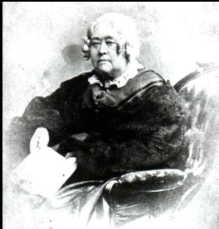
Elizabeth Peabody
In some ways, The Kitchen Garden Association, founded by Grace Dodge in 1880, bridges the gap between Mather’s early structure and Francke’s Realschule with Froebel’s kindergarten of play and Peabody’s ethos of cultivation. Thus from Mather’s religious "errand" to a formalized, scientific pedagogy for the industrial age utilized aspects of song, play, and gifting, in order to instill formal moral and industrial learning for “poor” children:
[t}he system is a combination of songs, exercises, and plays, designed in a thoroughly practical way to train a child in simply housework. It is divided into six distinct parts or occupations each taking a month to master. They comprehend the following details of domestic work: kindling fires, waiting on the door, bed- making, sweeping and dusting, completely; arranging a room with the manipulation of broom, whisk-broom, dusters, etc.; also all laundry processes, from the preparation of the tubs to the delicacies of polishing and folding; scrubbing; and laying a dinner-table in the due order of course…Last of all comes the mud-pie play…[a]ll the lessons are enlivened and emphasized with appropriate songs[8]
While the Kitchen Garden Association remained secular, it carried the "Pedagogical Essence" of the earlier German and Puritan influences. It operated on the belief of the Three P’s: Purity, Perseverance, and Pleasantness, the very Protestant notion that order in the home reflected order in the soul. By teaching a girl to precisely align a place setting or scientifically manage a budget, Dodge was continuing the work Mather began: using education to create a stable, moral, and "useful" citizenry.
Manuscript Letter from Elizabeth Peabody to Mary Slade,
Teachers College, Gottesman Libraries
The Kitchen Garden Association was an experimental prototype of a philanthropic endeavor to provide marginalized children with the moral and practical skills to adequately adjust to society, gain marketable skills for their class, and also fulfill a sense of play. In the end, KGA did not suffer from an enrollment issue, but rather from a lack of professional teachers—as most were volunteers. To solve the "teacher problem," Dodge dissolved the KGA and reorganized it into the Industrial Education Association.
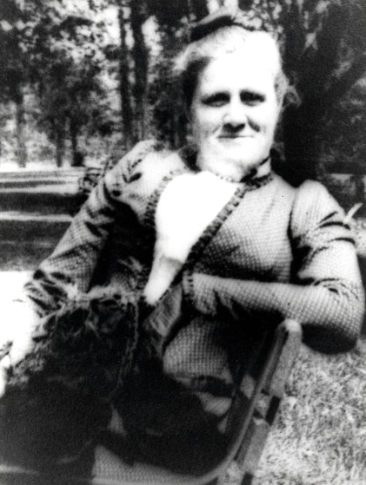
Grace Dodge, Teachers College Historical Photographs, Gottesman Libraries
The mission expanded from just the Kitchen Garden Association to promoting manual training and domestic science for both boys and girls. The Industrial Education Association became a vehicle for advocacy in education for the formalization of what D.C. Gilman of Johns Hopkins University called “the training of the hand”.[9] In this training of the hand, four primary categories were established: the physical, manual training, industrial education, and technical education:
Physical culture should be understood as the discipline of the entire body by which every organ receives its healthiest and most complete development. Manual training is restricted to the discipline of the arm, the wrist and fingers. Industrial education should refer to preparation for any useful pursuit however humble. And technical educa-
tion should include the specific discipline required for excellence in a profession, however exalted, or in the practice of an art however difficult.[10]
By 1887, Dodge and Nicholas Butler opened a headquarters at 9 University Place in New York, which included a library and classrooms becoming New York College for Teacher Training. However, the time was short-lived as—we are all well aware—the college soon moved to 120th street.
The trajectory from Cotton Mather’s "Ecclesiastical Cosmology" to Grace Dodge’s "Kitchen Gardens" reveals a consistent educational impulse across time: the belief that education must be as practical as it is profound. What began as a transatlantic correspondence between Puritan Boston and Pietist Halle—exchanging ideas on "Ragged Schools" and the professionalization of the Pedagogium—eventually solidified into the very bricks and mortar of Teachers College.
This legacy of integrating religious values with educational innovation remains a point of active reflection within the TC community through the early 20th century and beyond, as showcased in a religious exhibition at TC’s Educational Museum and as we pass by the beauty of the Milbank Chapel, and our administration celebrates and calls attention to an inclusive cross-section of religious tidings.
By revisiting these historical intersections, there is an underscores that the "training of the hand" advocated by Dodge and Butler was never merely a secular industrial necessity. Instead, it was the culmination of a centuries-long journey to understand "Spirit in ourselves", that moved along a continuum of pedagogy to eventually adopt a more secular, rational approach to education.
Additional Resources:
Congregational Library and Archives
The Correspondence of Augustus Hermann Francke
Froebel Archive for Childhood Studies
Elizabeth Palmer Peabody Papers
Amos Bronson Alcott Family Papers
Further Reading:
Alcott, A. B., & Shepard, O. (1938). The journals of Bronson Alcott (First edition.). Little, Brown and Company.
Bush, G. G. (n.d.). The First common schools of New England. https://tccolumbia.qualtrics.com/jfe/form/SV_1Lzt0sQEa7J9nQG
Circular of information. (n.d.). Industrial Education Association, College for the Training of Teachers.
Cornwallis, C. F. (1851). The philosophy of ragged schools. W. Pickering.
Festschrift zur zweihundertjährigen jubelfeier der Frankeschen stiftungen und der Lateinischen hauptschule am 30. : juni und 1. juli 1898. (1898). Buchdruckerei des Waisenhauses.
Ford, P. L. (1897). The New England primer, a history of its origin and development : with a reprint of the unique copy of the earliest known edition and many facsimile illustrations and reproductions. Printed for Dodd, Mead and Co.
Francke, A. H., Mather, C., & Francke, K. (1801). Cotton Mather and August Hermann Francke. [publisher not identified]. https://tccolumbia.qualtrics.com/jfe/form/SV_1Lzt0sQEa7J9nQG
Francke, A. H. (1885). A.H. Francke’s Pädagogische Schriften : Nebst der Darstellung seines Lebens und seiner Stiftungen (Zweite, durchgesehene und vervollständigte Ausgabe.). H. Beyer.
Dodge, G. H. (1875). Grace Dodge Collection.
Industrial Education Association. (1889). Monographs of the Industrial Education Association. Industrial Education Association.
Jahresbericht über die Realschule I. Ordnung zu Zwickau : auf das Schuljahr ... , womit zu den ... abzuhaltenden öffentlichen Prüfungen ganz ergebenst einladet. (1870). [publisher not identified].
Katalog der Lehrerbibliothek der Städtischen Realschule zu Dortmund : Zusammengestellt durch den Bibliothekar Professor Persuhn. (n.d.).
Mather, C., & Cheever, E. (1828). Corderius americanus A discourse on the good education of children, &c. &c. delivered at the funeral of Ezekiel Cheever, principal of the Latin school in Boston; who died, August, 1708, in the ninety-fourth year of his age. With an elegy and an epitaph. Dutton & Wentworth.
Mather, C., & Mather, I. (1862). The wonders of the invisible world. : Being an account of the tryals of several witches lately executed in New England. To which is added, A farther account of the tryals of the New-England witches. J.R. Smith.
Muelder, W. G., & Sears, L. (1941). The development of American philosophy ; a book of readings. Houghton Mifflin Company.
POTTER, W. A. (1891). The new buildings for the New York College for the Training of Teachers to be erected on west 120th street, New York city. [Heliotype Print Co.].
Sanborn, F. B., & Harris, W. T. (1893). A. Bronson Alcott ; his life and philosophy. Roberts brothers.
Cited works in essay:
[1] Mather, C., & Cheever, E. (1828). Corderius americanus A discourse on the good education of children, &c. &c. delivered at the funeral of Ezekiel Cheever, principal of the Latin school in Boston; who died, August, 1708, in the ninety-fourth year of his age. With an elegy and an epitaph. Dutton & Wentworth.
[2] Ibid.
[3] Benz, E. (1961). Ecumenical Relations between Boston Puritanism and German Pietism: Cotton Mather and August Hermann Francke. The Harvard Theological Review, 54(3), 159–193. http://www.jstor.org/stable/1508437
[4] Francke, A. H., Mather, C., & Francke, K. (1801). Cotton Mather and August Hermann Francke. [publisher not identified]. https://tccolumbia.qualtrics.com/jfe/form/SV_1Lzt0sQEa7J9nQG
[5] Peabody, E. P. (1836). Method of spiritual culture being an explanatory preface to the second edition of Record of a school. Published by James Munroe & Co. https://tccolumbia.qualtrics.com/jfe/form/SV_1Lzt0sQEa7J9nQG
[6] Ibid
[7] Peabody, E. P., & Manning, E. A. (1887). Education in the home, the kindergarten, and the primary school. Swan Sonnenschein. https://tccolumbia.qualtrics.com/jfe/form/SV_1Lzt0sQEa7J9nQG
[8] Huntington, E. (1901). How to teach kitchen garden, or, Object lessons in household work, including songs, plays, exercises, and games illustrating household occupations. Doubleday, Page & Co. https://tccolumbia.qualtrics.com/jfe/form/SV_1Lzt0sQEa7J9nQG
[9] Industrial Education Association. (1889). Monographs of the Industrial Education Association. Industrial Education Association.
[10] Ibid