Today in History: March on Washington
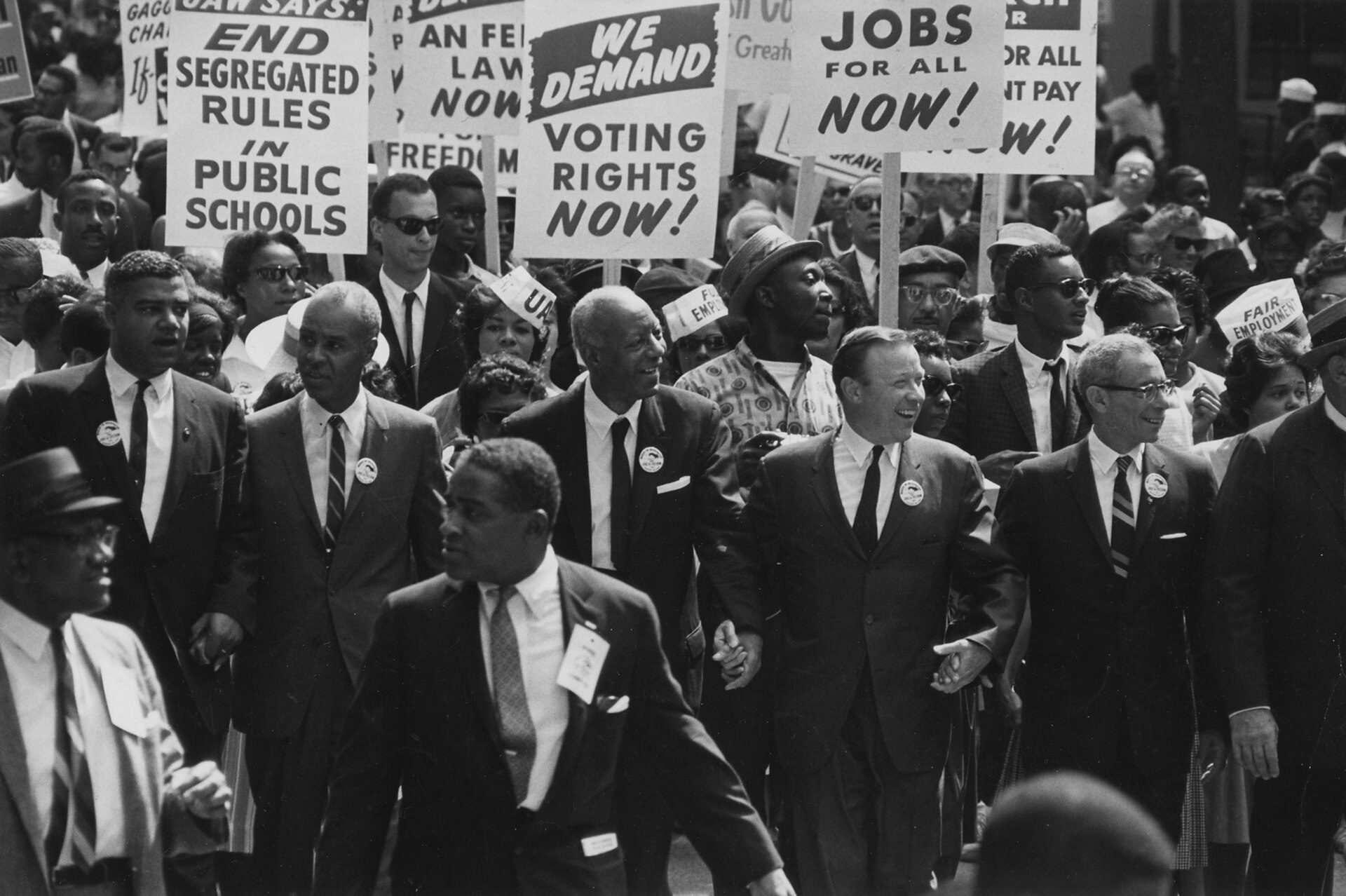
I say to you, today, my friend, so even though we face the difficulties of today and tomorrow, I still have a dream. It is a dream deeply rooted in the American dream. I have a dream that one day this Nation will rise up and live out the true meaning of its creed -- "we hold these truths to be self-evident that all men are created equal."
-- Martin Luther King, Jr. , from "I Have a Dream". August 28th, 1963.
One hundred years after the signing of the Emancipation Proclamation that declared the freedom of all enslaved peoples in the Confederate States, as many as 250,000 citizens marched peacefully from Constitution and Independence Avenues to the Lincoln Memorial in Washington, D.C. Coming from all over the nation, the marchers sought to draw attention to historic grievances among African Americans, particularly disproportionately high levels of unemployment, unequal wages, inadequate and segregated schools, lack of decent housing, and the inability to vote. Leaders came together from prominent civil rights organizations, among them: James Farmer, National Director of the Congress of Racial Equality (CORE); Reverend Martin Luther King, President of the Southern Christian Leadership Conference (SCLC); John Lewis, Chairman of the Student Non-violent Coordinating Committee (SNCC); A. Philip Randolph, President of the Negro American Labor Organization; Roy Wilkins, Executive Secretary of the National Association for the Advancement of Colored People (NAACP); and Whitney Young, Executive Director of the Urban League.
Martin Luther King, Jr. delivered his speech, "I Have a Dream" on this day at the Lincoln Memorial, going down in history as one of the most widely quoted and moving speeches in United States history. The historic 1963 March on Washington for Jobs and Freedom signified peaceful protest against systemic racism and the fight for legal, economic, and social equality. The Civil Rights Movement that began in the 1950s would continue through the 1960s -- and become precursor and inspiration for Black Lives Matter, a movement that began in 2013 to protest racial injustices and police brutality against Black people following the acquittal of George Zimmerman who shot and killed unarmed Black teenager Trayvon Martin in Sanford, Florida.
In 1970 President John Fischer of Teachers College, Columbia University, reflected on the contributions and legacy of Dr. Marin Luther King, Jr. -- whom he called "a good instructor and an illuminating teacher" -- saying that "the lesson of Dr. King's life and the lesson of his death is that love is more powerful than hate, conciliation more fruitful than conflict, and courage most admirable when it energizes compassion."
The following articles are drawn from Proquest Historical Newspapers, which informs and inspires classroom teaching and learning.
- Pierson, J. (1963, Aug 10). They Want It Big -- and Peaceful: Here's Blueprint for 'Greatest Demonstration' March on Washington. August 28, 100,000 Expected to Join Parade for Jobs and Freedom. New Journal and Guide (1916-)
- 'I Have a Dream.'(1968, Apr 13). New York Amsterdam News (1962-) Retrieved from https://ezproxy.cul.columbia.edu/login?url=https://www.proquest.com/newspapers/i-have-dreams/docview/226653402/se-2
- I Have a Dream: The Most Famous of the Thousands, of Speeches Given by Dr. Martin Luther King, Jr., Was Delivered August 28, 1963 at the March on Washington, D.C. for Civil rRghts. as America Pauses Monday, on the First National Holiday Commemorating the Life and Ideals of Dr. King. (1986, Jan 16). Call and Post (1982-)
- Colvin, L. (1992, Sep 02). Local Civil Rights Leaders Recall 1963 March on Washington. New Journal and Guide (1916-)
- Daniels, R. (2003, Jun 18). The 40th Anniversary of the March on Washington. New Pittsburgh Courier (1981-)
- Edney, H.T. (2003, Aug 22). Anniversary Marchers Seek to Rekindle Dr. King's 'Dream'. The Call (1933-)
- Toler, S.M. (2003, Aug 27). Torch Passed: March on Washington Ceremony Passes Civil Rights Torch to Hip-Hop Generation. New Pittsburgh Courier (1981-)
- Walters, R. (2003, Aug 28). Marching on Washington in the 21st Century. The Louisville Defender (1933-)
- Jackson, J. (2007, Aug 30). A National Day of Protest. The St.Louis American (1949-2010)
- Beasley, E. (2010, Sep 03). What Really Happened with the March on Washington. The Call (1933-)
Tips:
- Civil Rights in America: A Resource Guide. Library of Congress.
- Harris, D. (2019). The March on Washington and Its Legacy (First edition). Abdo Publishing. e-book.
- Haskins, J. (1993). The March on Washington (First edition). HarperCollins. Curriculum ; F200 .H35 1993.
- King, M. L., & Nelson, K. (2012). I Have a Dream (First edition). Schwartz & Wade Books. Curriculum ; E195.97.K5 A5 2012.
- Remarks at Memorial Service in Honor of Martin Luther King. (1970). John H. Fischer - Office of the President. Teachers College Digital Collections.
- Wittenstein, B., & Pinkney, J. (2019). A Place to Land : Martin Luther King Jr. and the Speech that Inspired a Nation (First edition). Holiday House. Curriculum ; E185.97.K5 W588 2019.
- Younge, G. (2023). The Speech : The Story Behind Dr. Martin Luther King Jr.’s Dream (Updated Edition) (Second edition). Haymarket Books. e-book.
Images:
- Poster Image: Civil Rights March on Washington, D.C. from Lincoln Memorial, Wikimedia Commons.
- Civil Rights March on Washington, D.C. (Leaders marching from the Washington Monument to the Lincoln Memorial) - NARA - 542010. Wikimedia Commons.
Need to keep current, look to the past, teach a topic? The Everett Cafe features daily postings of news from around the world, and also promotes awareness of historical events from an educational context. Be sure to check additional Cafe News postings on the library blog.


.jpg)
_-_NARA_-_542010.jpg)