Today In History: 22nd Amendment Is Ratified
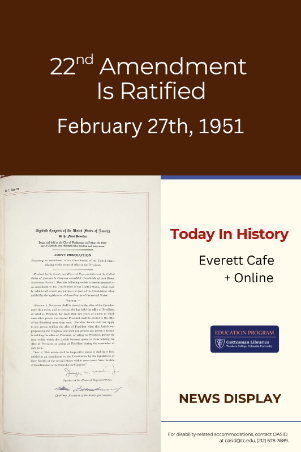
Section 1
No person shall be elected to the office of the President more than twice, and no person who has held the office of President, or acted as President, for more than two years of a term to which some other person was elected President shall be elected to the office of the President more than once. But this Article shall not apply to any person holding the office of President when this Article was proposed by the Congress, and shall not prevent any person who may be holding the office of President, or acting as President, during the term within which this Article becomes operative from holding the office of President or acting as President during the remainder of such term.
Section 2
This article shall be inoperative unless it shall have been ratified as an amendment to the Constitution by the legislatures of three-fourths of the several States within seven years from the date of its submission to the States by the Congress.
Twenty-second Amendment, Congress.gov.
Ratified by thirty-six of out forty-eight on February 27th, 1951, the Twenty-second Amendment to the United States Constitution sets the number of times the President can be elected to serve, with a limit of two terms or eight years in office. A vice president who assumes the presidency can serve up to 10 years, if they inherit less than two years of the former president's term.
Though Congress approved this change to government on March 21st, 1947, it took years to be implemented, despite examples set by former presidents George Washington and Thomas Jefferson who opted not to run for a third term. The only exception to practice was Franklin Delano Roosevelt, the 32nd president, who served a third and fourth term, from 1933 until his death in 1945. The amendment did not apply to Vice President Harry S. Truman who succeeded Roosevelt and then was elected in 1948.
Over the decades, term limits have been debated, with some favoring the repeal of the Twenty-second amendment, and others believing that it safeguards political stagnation, abuse of power, or dominating party politics. In 2026 we find ourselves looking ahead to how the next presidential election will play out on November 7th, 2028.
The following articles are drawn from Proquest Historical Newspapers, which informs and inspires classroom teaching and learning.
- Two-Term Limit for Presidents Now Law. (1951, Feb 27). Detroit Free Press (1923-)
- Baker, D. G. (1969, Oct 05). Political Power Abuse. New York Times (1923-)
- Commager, H. (1973, Sep 16). How Long Should a President Serve? Boston Globe (1960-)
- Dickenson, J. R. (1985, Sep 29). Catch-22nd. The Washington Post (1974-)
- Let's Discuss the Two-Term Limit. (1985, Oct 12). The Hartford Courant (1923-)
- Editorial: Eight Years Are Enough. (1986, Jul 30). The Hartford Courant (1923-)
- Cronin, T.E. (1987, Feb 23). Two Cheers for the 22nd amendment: The Two-Term Limit for Presidents Helps Prevent Political Stagnation. The Christian Science Monitor (1908-)
- Goodrich, L.J. E (1998, Nov 24). American Politics a Quiet Revolution. The Christian Science Monitor (1908-)
- Parran, J. D. (2004, Oct 24). Spirit of 22nd Amendment. The Washington Post (1974-)
- 2-Term Amendment in Force as the 36th State Ratifies. New York Times Archive. (2022, Feb 27). New York Times (1923-)
Tips:
- Korzi, Michael J. Presidential Term Limits in American History : Power, Principles & Politics. 1st ed., Texas A&M University Press, 2011. e-book.
- Nyznyk, Darryl. The Third Term. Cross Dove Pub., 1997. e-book.
- Yalof, David Alistair. George Washington and the Two-Term Precedent. First edition. University Press of Kansas, 2023. e-book.
Images:
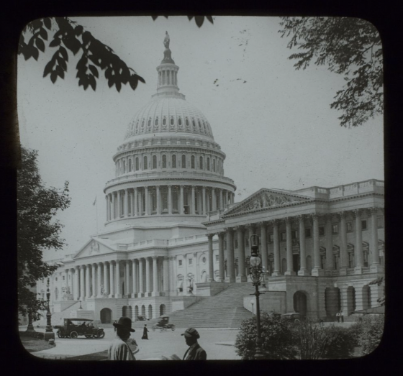
- U.S. Capitol from the Northeast, Washington D.C., Rothman Lantern Slide Collection, Courtesy of Teachers College, Columbia University.
- Poster Image: The 22nd Amendment, Courtesy of the National Archives.
Need to keep current, look to the past, teach a topic? The Everett Cafe features daily postings of news from around the world, and also promotes awareness of historical events from an educational context. Be sure to check additional Cafe News postings on the library blog.