Today In History: Deepest Dive in Human History
"Yes; I love it! The sea is everything. It covers seven tenths of the terrestrial globe. Its breath is pure and healthy. It is an immense desert, where man is never lonely, for he feels life stirring on all sides. The sea is only the embodiment of a natural and supernatural existence. It is nothing but love and emotion; it is the 'Living Infinite,' as one of your poets said. In fact, Professor, Nature manifests herself in it by her three kingdoms -- mineral, vegetable, and animal. The sea is the vast reservoir of Nature. The globe began with sea, so to speak; and who knows if it will not end with it? The sea does not belong to despots. In it is supreme tranquillity. Upon its surface men can still exercise unjust laws, fight, tear one another to pieces, and be carried away with terrestrial horrors. But at thirty feet below its level, their reign ceases, their influence is quenched, and their power disappears. Ah! Sir, live -- live in the bosom of the waters! There only is independence! There I recognize no masters! There I am free!"
-- Captain Nemo, in Twenty Thousand Leagues Under the Sea, by Jules Verne (Open Road Integrated Media, p.60).
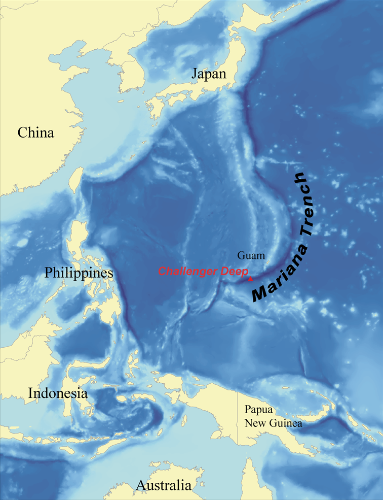
On January 23rd, 1960, two oceanographers -- Lieutenant Commander Don Walsh of the United States Navy and co-pilot Jacques Piccard, a Swiss explorer -- made history in reaching via bathyscaph[e] (or "deep boat" in Greek), the deepest point in the globe. Their five-hour journey in a six foot submersible to the bottom of Challenger Deep, seven miles, or 35,800 feet beneath the surface of the Pacific Ocean in the Mariana Trench, some 210 miles southwest of Guam, broke the world record, previously held by Russia. The Trieste was a Swiss-designed and Italian-built deep-diving research vessel that sought to gather data on marine biology, the ocean floor, water temperature, and water transmission to better understand the future health of our planet, while also paving the way for military operations -- strategic surveillance; submarine warfare; and seabed and rescue operations. Although a window inside the entrance hatch cracked, rocking the bathyscaph with an explosion two thirds of the way down, the Trieste continued on its journey to touch the bottom. There it stayed for twenty minutes before ascending back to the surface. Don Walsh and Jacques Piccard remained strong advocates for deep sea exploration and continued their research and ocean journeys, receiving many awards and distinctions for their service.
The following articles are drawn from Proquest Historical Newspapers, which informs and inspires classroom teaching and learning.
- Bathyscaphe Withstands Enormous Sea Pressure: Capability Illustrated. (1960, Jan 25). The Christian Science Monitor (1908-)
- Diver Debunks Terrors of Ocean Bottom: Whiteness of Pacific Depth Told. (1960, Jan 31). Chicago Daily Tribune (1923-1963)
- Carr, A. (1961, Feb 05). Journey to an End of the World: Seven Miles Down. New York Times (1923-)
- R.C.C. (1961, Feb 16). Dimension of Depth. The Christian Science Monitor (1908-)
- Dolbier, M. (1961, Feb 19). Books and Authors: Jacques Piccard: To the Lowest Depths. New York Herald Tribune (1926-1962)
- Burgess, E. Seaways Like Skyways Beneath the Oceans: Mariana Trench Explored Investments, Backed Experience, Sought Friendships, Formed Underwater Waves Found, Data Amassed. The Christian Science Monitor (1908-)
- Mama, H. P. (1971, Oct 24). Exploring the Oceans. The Times of India (1861-)
- R., Y. (1980, Jan 23). Profondeur 10916 Mètres. Le Monde (1944-2000)
- Smyth, J. (2008, Nov 04). Death of Intrepid Explorer Who Opened Up the Oceans' Depths: Jacques Piccard Was an Adventurer Whose Real-Life Exploits Inspired Cartoon and Film Legends. The Irish Times (1921-)
- Murton, B. (2008, Nov 06). Jacques Piccard: A Swiss Marine Explorer, He Made History With His 1960 Descent of the Pacific. The Guardian (1959-2009)

Tips:
- Berger, Wolfgang H, and Elizabeth Noble Shor. Ocean : Reflections on a Century of Exploration. 1st ed., University of California Press, 2009. e-book.
- Kornprobst, Jacques, et al. À la Conquête des Grands Fonds : Techniques D’étude de la Géologie Marine. 1st ed., Éditions Quæ, 2011. e-book.
- National Research Council, Committee on Exploration of the Seas. Exploration of the Seas : Voyage into the Unknown. 1st ed., National Academies Press, 2003. e-book.
- Polmar, Norman, and Lee J. Mathers. Opening the Great Depths : The Bathyscaph Trieste and Pioneers of Undersea Exploration. Naval Institute Press, 2021. e-book.
- Shannon, Terry, and Charles Payzant. The Sea Searchers ; Men and Machines at the Bottom of the Sea. Golden Gate Junior Books, 1968. Closed Stacks Curr ; GC66 .S52.
- Snyder, Dick. The Trieste ; the Story of the United States Navy’s First Inner Space Ship. Golden Gate Junior Books, 1964. Closed Stacks Curr ; VA65.T67 S6.
- Verne, Jules. Twenty Thousand Leagues Under the Sea. C. Scribner’s Sons, 1954. Closed Stacks Juvenile ; PZ3.V594 Tw4 1954.
Images:
- Mariana Trench Map, Wikimedia Commons.
- Bathyscaphe Triest, Wikimedia Commons.
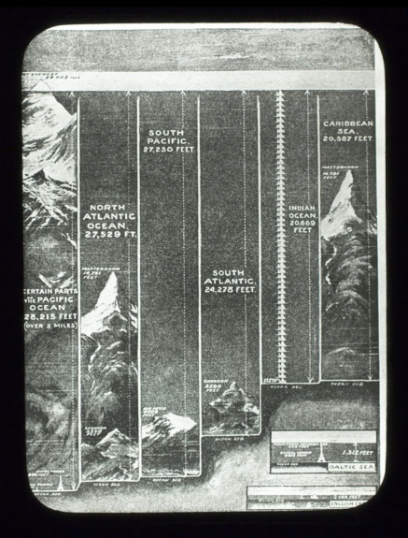
- Oceans Depth, Rothman Lantern Slide Collection, Teachers College, Columbia University.
Need to keep current, look to the past, teach a topic? The Everett Cafe features daily postings of news from around the world, and also promotes awareness of historical events from an educational context. Be sure to check additional Cafe News postings on the library blog.