Today in History: Horatio Alger Is Born
I have mentioned Dick's faults and defects, because I want it understood, to begin with, that I don't consider him a model boy. But there were some good points about him nevertheless. He would not steal, or cheat, or impose upon younger boys, but was frank and straightforward, manly and self-reliant. His nature was a noble one, and had saved him from all mean faults. I hope my readers will like him as I do, without being blind to his faults. Perhaps, although he was only a boot-black, they may find something in him to imitate.
-- Horatio Alger, Ragged Dick: Street Life in New York with the Boot-Blacks. pp. 16-17.
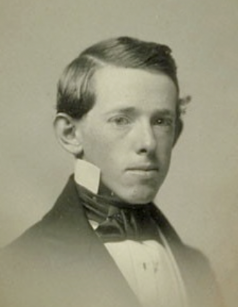
Son of Unitarian minister Horatio Alger, Sr. and Olive Augusta Fenno, Horatio Alger was born on January 13th, 1832 in Chelsea, Massachusetts. Of "genteel poverty", he was homeschooled in the classics by his father and went on to attend affordable local preparatory schools before being admitted at the age of fifteen to Harvard University. After graduating in 1852 with many academic awards and honors, he briefly attend Harvard Divinity School, but opted instead to teach at a boy's boarding school. He wrote short pieces and poems and became a pastor with the First Unitarian Church and Society of Brewster, Massachusetts.
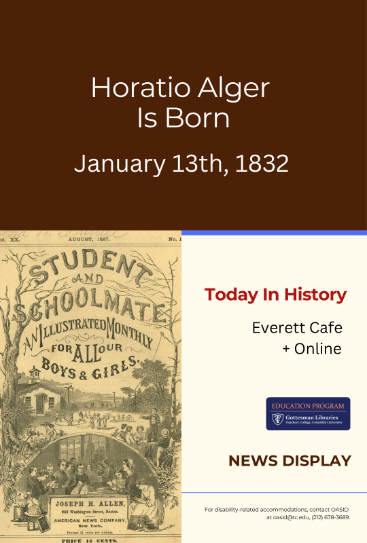
Alger's interest in understanding street life and aiding the welfare of vagrant children took him to New York City, where he published "Ragged Dick" in twelve installments for the serialized Student and Schoolmate. Post Civil War, he tutored both the wealthy and destitute, taking poor boys into his own home. His stories about Ragged Dick, the shoeshine boy, expanded into a full-length novel. His literary success stemmed from the popular appeal of the fictional character's rise from "rags to riches" and his belief in the American Dream -- setting the model for the "Alger hero" in Luck and Pluck and the Tattered Tom series. Alger's books sold over twenty million copies, with resurgent interest over the decades, though their actual literary merit is debated.
The following articles are drawn from Proquest Historical Newspapers, which informs and inspires classroom teaching and learning.
- Raines, H. (1928, Apr 22). Horatio Alger Created 119 Synthetic Heroes: Horatio Alger, Moralist. New York Times (1923-)
- Holbrook, S (1944, Jul 02). Horatio Alger Jr. and Ragged Dick: The Horatio Alger World. New York Times (1923-)
- This Day in History: Jan. 13 -- The Birth of Horatio Alger.. (1946, Jan 13). Chicago Daily Tribune (1923-1963)
- Cooper, I. (1956, Feb 23). Horatio Alger, Bible Gave Him Courage: "But That Day I Did Not Run". Daily Boston Globe (1928-1960)
- Meehan, T. (1964, Jun 28). A Forgettable Centenary -- Horatio Alger's: Who Cares That in 1864 Appeared His Very First Book, 'Frank's Campaign' -- Who? Horatio Alger. New York Times (1923-)
- Borland, H. (1964, Jul 19). He Made the American Success Story a Success: From Rags to Riches: Horatio Alger Jr. and the American Dream. New York Times (1923-)
- Starrett, V. (1967, Jan 08). Horatio Alger, the Rags to Riches Boy. Chicago Tribune (1963-1996)
- Levensohn, A. (1967, Jul 27). Horatio Alger: A Myth Revisited: Back to Those Heroes. The Christian Science Monitor (1908-)
- Anderson, J. (1978, May 24). Add 14 Chapters to Horatio Alger's Story: Tempo Horatio Alger Alive and Well in America. Chicago Tribune (1963-1996)
- DiBacco, T. V. 1983, Dec 28). Read Horatio Alger -- It's Still Worthwhile. The Sun (1837-)
Tips:
- Enslin, Morton Scott. A Checklist of Horatio Alger, Jr. 1959. e-book.
- Gutjahr, Paul C. Bestsellers in Nineteenth-Century America: An Anthology. Edited by Paul Gutjahr, 1st ed., NBN International, 2016. e-book.
- Hoyt, Edwin P. Horatio’s Boys ; the Life and Works of Horatio Alger, Jr. [First edition]., Chilton Book Co., 1974. Stacks ; PS1029.A3 Z68.
- Weiss, Richard. The American Myth of Success; from Horatio Alger to Norman Vincent Peale. Basic Books, 1969. 5th Floor Stacks & Loft ; HN57 .W45.
- Books by Horatio Alger held at Gottesman Libraries.
Images:
- Alger on Harvard Commencement Day, 1852, Wikimedia Commons.
- Student and Schoolmate, August 1867, Wikimedia Commons.
Need to keep current, look to the past, teach a topic? The Everett Cafe features daily postings of news from around the world, and also promotes awareness of historical events from an educational context. Be sure to check additional Cafe News postings on the library blog.