Teaching the Revolution: 250 Years of Early American History in the Classroom
July 4th, 2026 marks the 250th anniversary of the establishment of the United States of America, a nation forged from under the tyrannical rule of Great Britain. In honor of this anniversary, I want to highlight certain archival materials available in the Special Collections of Gottesman Libraries at Teachers College, Columbia University, searchable via the EDUCAT+ online catalog. The works discussed below not only shed light on the causes and consequences of the American Revolution, but also offer a window into how generations of educators have understood and taught this defining time in U.S. history.
Starting with one of the oldest works pertaining to the American Revolution in our curriculum archive, History of the American Revolution: Intended as a Reading-Book for Schools by Samuel Williams, L.L.D. (1824) details several battles fought throughout the Revolutionary War and examines the nation’s founding documents that emerged from the conflict.

Woodcut Illustrations from “History of the American Revolution: Intended as a Reading-Book for Schools” by Samuel Williams (1824) depicting the Destruction of Tea in Boston Harbor (November, 1773), the Battle at Bunker Hill and Burning of Charleston (June 17th, 1775), and the Surrender of Lord Cornwallis, at Yorktown (October 19th, 1781) – Teachers College, Gottesman Libraries |
Williams was a dedicated academic, serving as both an astronomer and philosopher at Harvard University. There, he assisted John Winthrop on his expedition to Newfoundland and later taught John Quincy Adams, the sixth president of the United States. Williams’ sentiments about the Revolution first appeared in the Rural Magazine in 1795 through a series of installments published only nineteen years after the founding of the United States. The text examined here, which compiled those articles into a textbook format, was published posthumously in 1824. Keeping in mind the young readers of Williams’ text, the publisher states in the preface that “A work of this kind has long been wanted in our common schools – and to supply this defect, the present volume is intended,” [2] explicitly identifying the student population as the intended audience.
This publication stands out in the curriculum collection of Gottesman Libraries as the only student-centered text on the American Revolution written by a firsthand observer of the nation’s formative years. Due to the historic proximity of the textual account, Williams’ work provided a timely pedagogical approach to teaching United States revolutionary history, despite the rather myopic account of the circumstances [3].
Six years after the compilation of Williams’ text, Nathaniel Dwight’s Sketches of the Lives of the Signers of the Declaration of Independence Intended Principally for the Use of Schools was published in 1830. Nathaniel, the brother of the eighth Yale president Timothy Dwight IV and son of Major Timothy Dwight III and Mary Dwight, experienced adolescence during the rise of a new nation. In his adulthood, Dwight was both an author and educator, writing books for the youth in early America. His text in our archive profiles all 56 signers of the Declaration of Independence, offering comprehensive biographies of each individual. By detailing their backgrounds, education, and achievements, Dwight offers students insight into the historical figures who laid the foundation for what would become the United States.
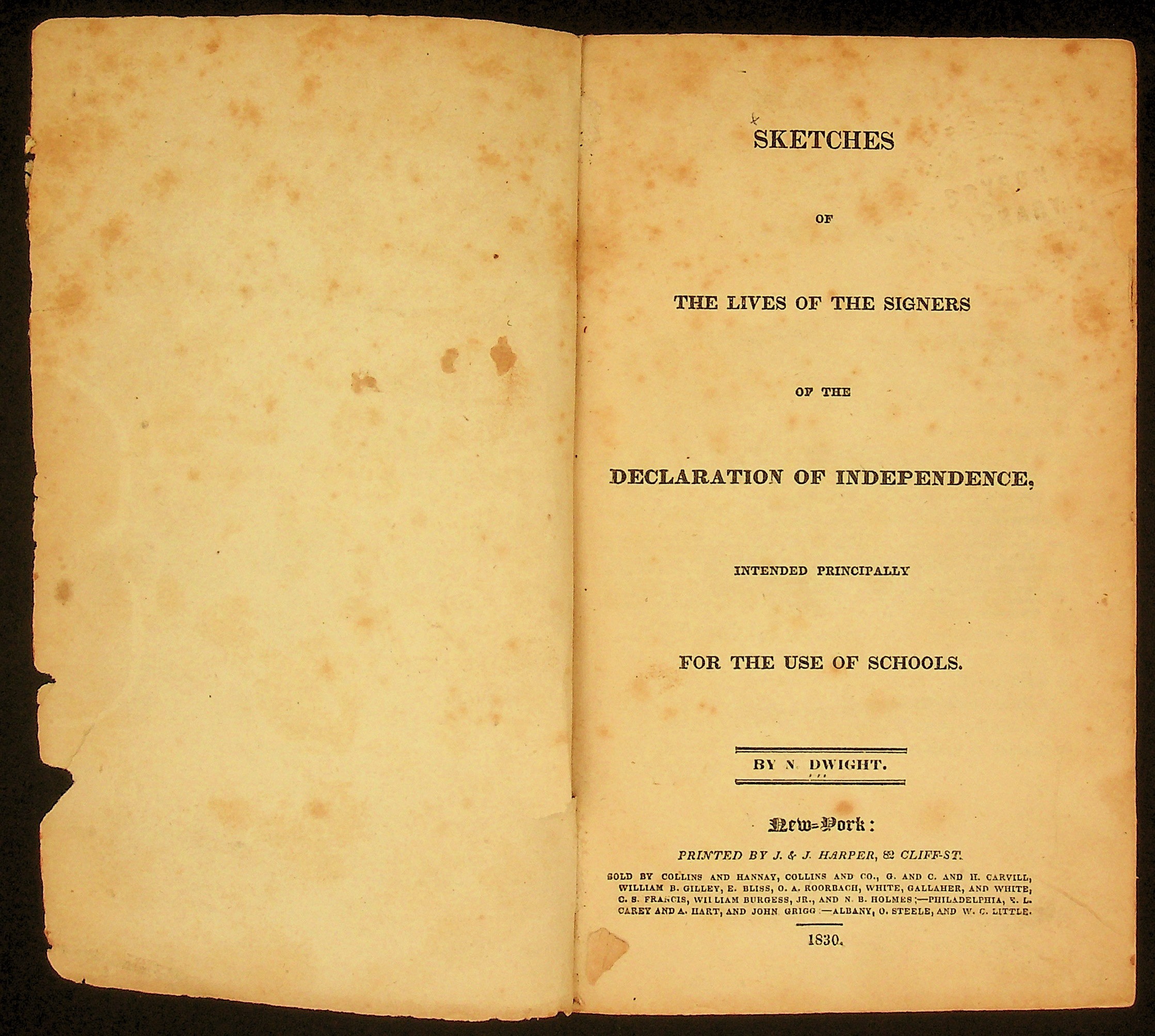
Title Page (1830) – Teachers College, Gottesman Libraries |
By noting that “the following work has been compiled principally with a view to its introduction into schools, throughout the country,” [4] Dwight establishes that this text was created for wide-scale student use, an intention further supported in the publication of several subsequent editions. He goes on to state that “The history of them [the defenders of the rights of the United States] which has been published, is too voluminous, and too expensive, for a very large proportion of the community; and altogether inconvenient to be used as a reading book for schools” [5]. The claim that historical texts were often inaccessible for the broader American population and that this book was intended for young audiences highlights an explicit commitment to creating approachable, learner-centered accounts of colonial United States history.
“The aim has been not only to interest children in the great men of their own country, but to stimulate them to the cultivation of the lofty virtues of which they read…” [6].
In 1898, the American Book Company published Hélène Adeline Guerber’s The Story of the Thirteen Colonies as part of their Eclectic School Readings series. Writing under the pseudonym H.A. Guerber, she chronicles stories about key moments in Colonial American history, from European exploration to the Revolutionary War. In contrast to the texts by Williams and Dwight discussed above, Guerber’s work not only presents a more condensed account of the American Revolution, but does so in a style that is clearly tailored to young readers.
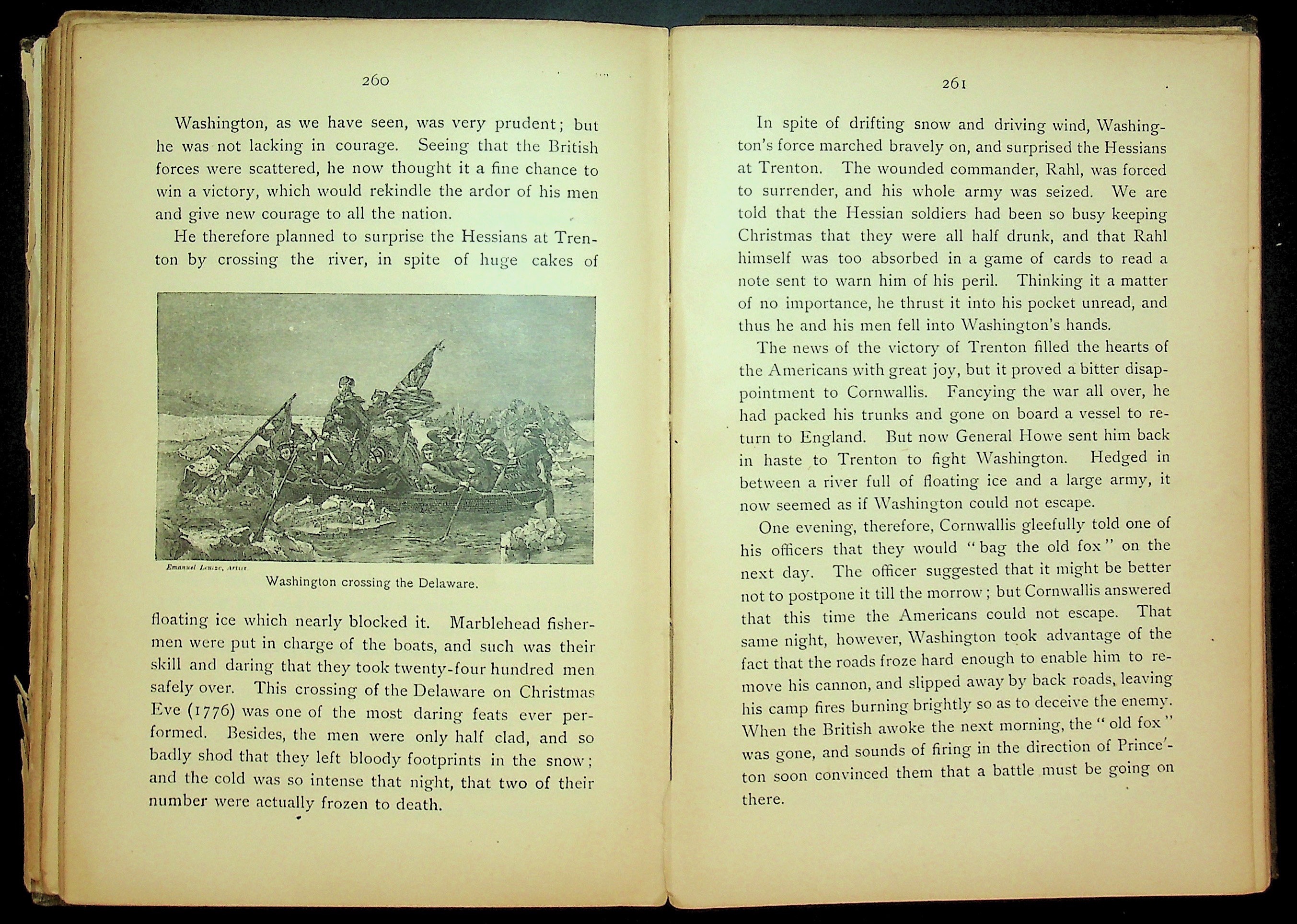
“Story of the Thirteen Colonies” by H.A. Guerber (1898), Page 260-261, includes art by Emmauel Leutze (1851) – Teachers College, Gottesman Libraries |
As an educator herself, the author seems to have intentionally designed this book for student learning: the prose is accessible, the pages feature illustrations, and the text repeatedly emphasizes the moral virtues of the historical figures. These features distinguish the volume within Gottesman Libraries’ curriculum materials, as it highlights active moral engagement as opposed to the strict memorization of facts about Colonial America.
Our American Revolution curriculum texts of the early 20th century reflect the progressive education movement of the era, defined by individualized learning, problem-solving, and student responsibility that is self-imposed [7]. As for materials made for in-school use, it featured a significant shift away from traditional textbooks, with a push for learner-centered texts over content-centered texts [8] in the United States.
Published in 1936, Teachers Manual: For the Beginnings of the American People and Nation by Mary G. Kelty outlines methods to engage students with the American Revolution. It also defends the validity of each method in the social sciences classroom – an interdisciplinary field of study promoted by the National Council for the Social Studies in 1921 [9]. Specifically referencing the middle grades, Kelty makes the case for independent and group reading, classroom discussion, picture and map study, creative activities, connections to present-day conditions, drills, and testing.
Intended to accompany her textbook of the same name, the guide provides teachers with instructional strategies for activities that correspond to each unit and story in the student-facing textbook. Evident in the image below are directions for educators on how to teach Unit 5B, “How the Revolution was Fought,” focusing on the “Danger to the Cause in the Middle Colonies” story.
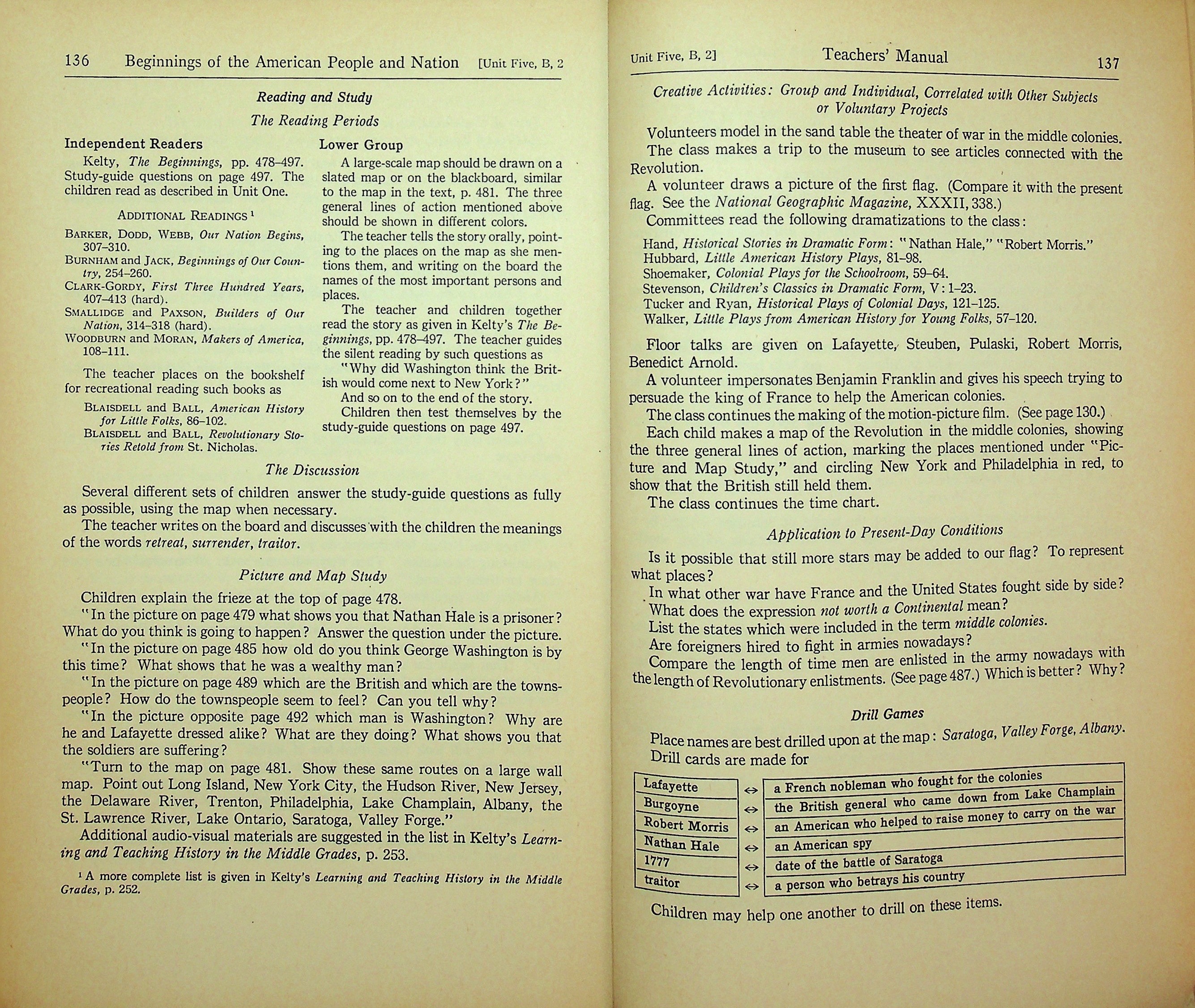
“Teachers Manual: For the Beginnings of the American People and Nation” by Mary G. Kelty (1936), Pages 136-137 – Teachers College, Gottesman Libraries |
Supporting the shifting discourse towards a more active engagement with the American Revolution, our curriculum archive also contains independent student workbooks that reflect the growing demand for individualized education. In an attempt to solve the varying learning paces of students in the same classroom, Carleton Washburne’s Winnetka Plan developed for Winnetka, Illinois in 1919 allowed for students to work independently, advancing to a new subject matter when they had mastered their current material [10]. According to Washburne, individualized work allowed instruction to fit the “individual differences of ability and individual stages of growth” of children [11]. These qualities are reflected in the American Revolution workbooks in our archive, as they invite students to independently respond in the text directly, positioning them as active participants in their learning.
The Pupil’s Guide To Accompany Kelty and Sister Blanche Marie’s Early American Life by Mary G. Kelty and Blanche Marie McEniry (1943) is an example of an interactive, individualized history workbook designed to pair with students’ textbook reading.
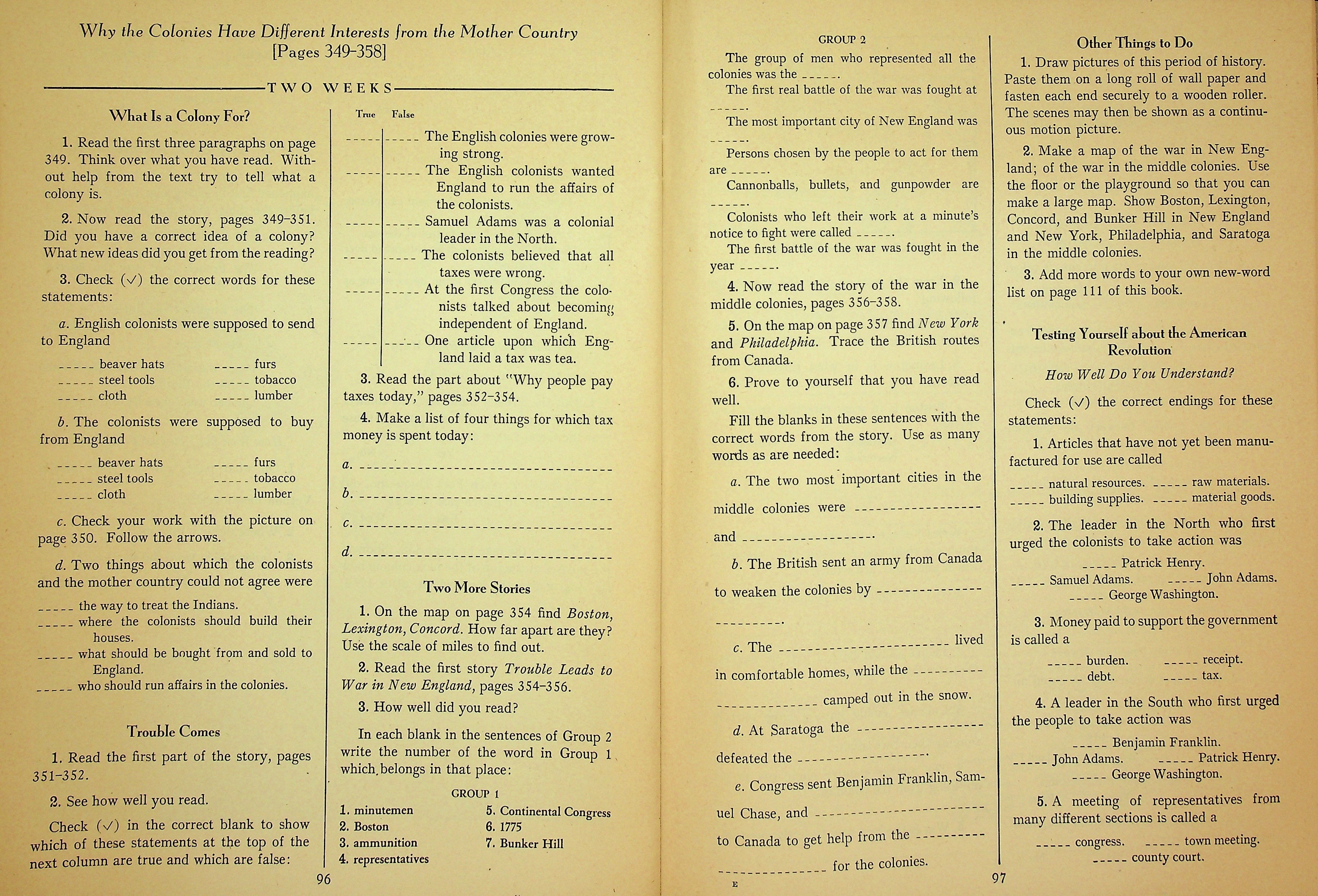
“The Pupil’s Guide To Accompany Kelty and Sister Blanche Marie’s Early American Life” by Mary G. Kelty and Blanche Marie McEniry (1943), Pages 96-97 – Teachers College, Gottesman Libraries |
Paragraphs inscribed under the “To the Teacher” message on the inside cover explain the central purpose of the text, noting that “pupil development in initiative, self-reliance, and self direction… has been an objective of paramount importance in determining the experiences provided for in this guide” [12]. With a focus on the early history of the United States, the workbook prompts students to engage with reading comprehension, vocabulary, and American geography, fostering a greater student autonomy and responsibility for their own learning.
“How the fundamental charter of our liberty came into being – one of the greatest stories of our country’s past – is told here by a distinguished historian and experienced writer for children” [13].
Henry Steele Commager’s The Great Declaration: A Book for Young Americans (1958) is a text intended for youth audiences with accessible language and imagery. It is also relatively short in length, reading like a hybrid between a picture book and a chapter book. Commager writes in a way designed to bring readers in, describing the American Revolution as a narrative at the end of the first chapter. “Let us turn, now, to the details – details that will never lose their fascination. We begin by introducing some of the leading actors in the great historical drama” [14]. This set-up, complete with an illustration of two founding fathers underneath, captures readers’ attention and transforms the revolution from a textbook-based account of facts to an engaging narrative. The remainder of the book builds on this introduction, quoting excerpts from letters and autobiographies of America’s first leaders, constructing a story designed to foster a more personal connection for students learning about the formation of the United States.
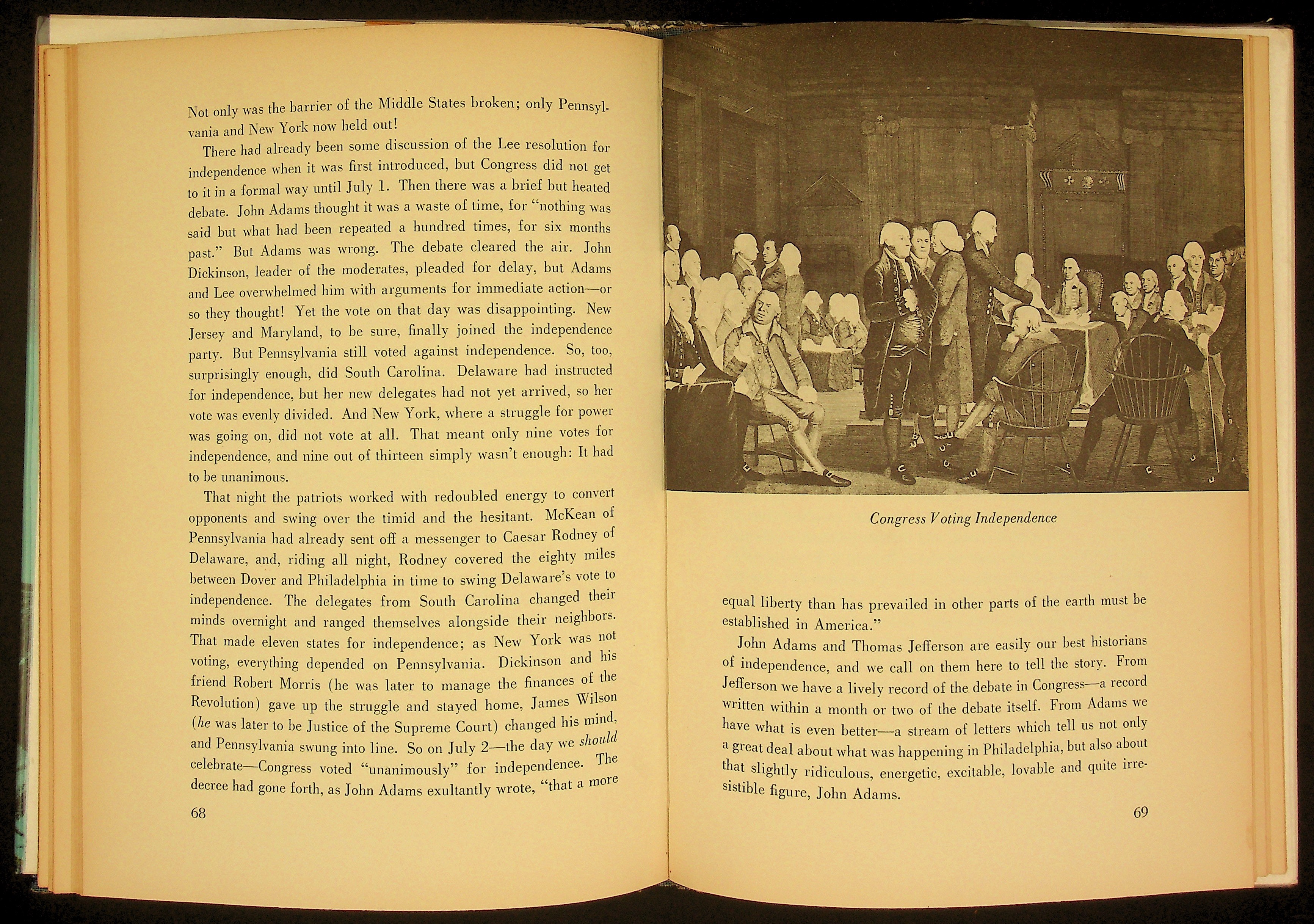
“The Great Declaration: A Book for Young Americans” by Henry Steele Commager (1958), Pages 68-69 – Teachers College, Gottesman Libraries |
By identifying and analyzing how the teaching of the American Revolution evolved in the United States over time, educators and scholars are better positioned to understand both how early American history was conveyed and how broader trends in educational publishing have shifted. While the central historical messages have remained relatively consistent, the ways in which students engage with this material have changed significantly. Examining textbooks, paired reading guides, teacher manuals, and student workbooks housed at Gottesman Libraries allows us to trace how generations of students have learned about the American Revolution and establishment of the United States as an independent nation over the past 250 years.
Archival Materials at Gottesman Libraries:
- Williams, S. (1824). A History of the American Revolution: Intended as a Reading-Book for Schools. W. Storer.
- Dwight, N. (1830). Sketches of the Lives of the Signers of the Declaration of Independence Intended Principally for the Use of Schools. J.&J. Harper.
- Guerber, H.A. (1898). Eclectic School Readings: The Story of the Thirteen Colonies. American Book Company.
- Kelty, M. G. (1936). Teachers’ Manual for the Beginnings of the American People and Nation. Ginn and Company.
- Kelty, M. C., & McEniry, B. M. (1943). The Pupil’s Guide To Accompany Kelty and Sister Blanche Marie’s Early American Life. Ginn and Company.
- Commager, H. S. (1958). The Great Declaration: A Book for Young Americans. The Bobbs-Merrill Company, Inc.
Additional Resources & Further Reading:
On the referenced authors, publishers, and families…
- Samuel Williams Papers, 1732-1811 (University of Vermont)
- Dwight Family Papers, 1713-1937 (Yale University)
- Dwight Family Papers, 1795-1866 (New York Public Library Archives & Manuscripts)
- American Book Company Records (Syracuse University)
- Henry Steele Commager Papers, 1920-1998 (Amherst College)
- Mary Gertrude Kelty
- Barton, K. C. (2002). Mary Gertrude Kelty. In M. S. Crocco & O. L. Davis, Jr. (Eds.), Building a Legacy: Women in Social Education, 1784-1984 (pp. 65-66). National Council for the Social Studies.
On Education in and about Early America…
- The American Revolution in Our Schools, 1783-Today (American Revolution Institute)
- Introduction to the History of America [first book printing of the constitution] by John McCulloch (The Gilder Lehrman Institute of American History)
- Save America’s Treasures, Teaching Young Americans: The Early American Schoolbook Collection (Michigan State University)
- Social Studies and the Birth of National Council for the Social Studies: 1783-1921 (NCSS)
- Jeynes, W. H. (2007). The Effects of the Revolutionary War Era on American Education. In American Educational History: School, Society, and the Common Good (pp. 31-60). SAGE Publications, Inc. https://doi.org/10.4135/9781452232331.n2
- Nash, M. A. (2009, November). Contested Identities: Nationalism, Regionalism, and Patriotism in Early American Textbooks. History of Education Quarterly, 49(4), 417-441.
Works Cited in Essay:
[1] Williams, S. (1824). A History of the American Revolution: Intended as a Reading-Book for Schools. W. Storer.
[2] Ibid.
[3] Smithsonian National Museum of American History. (n.d.). A History of the American Revolution. National Museum of American History. https://americanhistory.si.edu/ne/collections/object/nmah_1460964
[4] Dwight, N. (1830). Sketches of the Lives of the Signers of the Declaration of Independence Intended Principally for the Use of Schools. J.&J. Harper.
[5] Ibid.
[6] Guerber, H.A. (1898). Eclectic School Readings: The Story of the Thirteen Colonies. American Book Company.
[7] Kretchmar, J. (2019). Progressive Education. EBSCO. https://www.ebsco.com/research-starters/education/progressive-education
[8] Reynolds, J. C. (1976). American Textbooks: The First 200 Years. Educational Leadership, 274-276.
[9] Donnelly, M. (2019). Teaching Social Studies. EBSCO. https://www.ebsco.com/research-starters/social-sciences-and-humanities/teaching-social-studies
[10] Washburne, C. W. (1975). The Individual System in Winnetka. The Elementary School Journal, 75, 42-53.
[11] Washburne, C. (1943, January). The Aims of the Winnetka Public Schools. Bulletin of the Polish Institute of Arts and Sciences in America, 1(2), 382-393.
[12] Kelty, M. C., & McEniry, B. M. (1943). The Pupil’s Guide To Accompany Kelty and Sister Blanche Marie’s Early American Life. Ginn and Company.
[13] Commager, H. S. (1958). The Great Declaration: A Book for Young Americans. The Bobbs-Merrill Company, Inc.
[14] Ibid.