Today In History: First Jukebox
I walked into a honkey-tonkey
just the other day
I dropped a nickel in the
juke box just to hear it play
I didn't have no tune in
mind, I didn't wait to choose
Just dropped a nickel in the slot
and I played the juke box blues
-- Maybelle Carter and Helen Carter, from "Juke Box Blues", Sung by June Carter Cash (1953)
On November 23rd, 1889 the first jukebox made its debut in San Francisco's Palais Royale Saloon, located at 303 Sutter. Known as the "nickel-in-the-slot player", it was conceived by Louis T. Glass and William S. Arnold who modified the Edison Class M electric phonograph and had it constructed by Pacific Phonograph Company; music lovers could pay five cents to listen via earpiece to a single wax-cylinder recording through a tube. The nickelodeon fitted into an oak cabinet complete with four listening stethoscopes and it was an overnight sensation, drawing in as much as a thousand dollars in just six months.
The popularity of this innovative and fun musical machine spread. In 1934 Wurlitzer stepped in to create a more robust version that was outfitted with carousels, providing a larger selection of music. The iconic jukebox of the Big Band era, the original Wurlitzer played ten 78 RPM one-sided records, then expanded to twenty-four, before the advent of 45 RPM records that could play both sides of the vinyl recording with a selection of 50 different records and 100 songs. Other American jukebox companies, including Seeburg, Rock-ola, and Ami-Rowe, followed suit.
How exactly did the the term "jukebox" enter in? Nickel-in-the-slot machines were placed in lively dance halls, known as "juke joints" or "juke houses", where people drank, danced, and listened to music. By 1939 or 1940, the term was mainstream, as the music industry grew and pop became more readily available -- in cafes, restaurants, bars, and other venues.
Today, jukeboxes are collector's items and evoke a certain nostalgia for days of old when people convened to listen to music -- and responded to musical tastes in public settings. Remember colorful bubbling light tubes, glowing arches, chrome trim that livened movement to rock n' roll, country, blues, folk? How listeners noted with approval or not another's song choice in a bustling diner or coffee shop? To boot, over the last few years, vinyl has seen a comeback -- appealing as a tangible alternative to digital streaming -- while digital jukeboxes conveniently allow you to send your music selections from your phone.
The following articles are drawn from Proquest Historical Newspapers, which informs and inspires classroom teaching and learning.
- Juke-Box Cost. (1946, Dec 20). Los Angeles Times (1923-1995)
- Jones, S.V. (1964, Aug 08). Jukebox Is Patented to Sell the Records It Plays: Device Permits a Customer to Select and Purchase Both Sides of Platter. New York Times (1923-)
- Bridges, L. (1978, Nov 03). Jukeboxes: Music A Pub Tour with Eclectic Selections by the Numbers. Chicago Tribune (1963-1996)
- Haswell, C. (1983, Nov 06). Collector Stalks the Vanishing Jukebox. The Hartford Courant (1923-)
- Cobb, N. (1985, Apr 26). King of the Jukeboxes: The Wondrous Wurlitzer Deserves a Gold Platter. Boston Globe (1960-)
- Galloway, P. (1986, Jan 16). Jukebox Jim: A Love Affair with Music Machines. Chicago Tribune (1963-1996)
- Harrington, R. (1988, Nov 23). The Jukebox: A Century of Spinning: The Juke Century. The Washington Post (1974-)
- Landsberg, M. (1989, Nov 19). A Golden Age: Jukebox Turns 100 and Stirs Memories of That Old-Time Rock 'N' Roll. Los Angeles Times (1923-1995)
- Collins, S. (1997, Jan 27). Hey, Juke ... Take an Old Song and Make It Better: Music: Digital Jukeboxes Are on the Horizon--But Will They Push the Public's Button? Los Angeles Times (1996-)
- Kuipers, D. (2006, Aug 10). Keeping the Jukes Jumping: Jukebox Heroes They Are to the Music Industry What Unicorns Are to Reality: Magical, Mythical Beasts. but Spinning Those Tunes on Vinyl, They're the Life of the Party. Los Angeles Times (1996-)
Tips:
- Bouillot, C., & Cadiat, A.-C. (2015). Spotify, Music for Everyone : Wuel Avenir pour le Géant de la Musique en Streaming? (1st ed.). 50Minutes. e-book.
- Majer, G. (2005). The Velvet Lounge: On Late Chicago Jazz. (1st ed.). Columbia University Press. e-book.
- Please, V. M. (2017). Vinyl Me, Please : 100 Albums You Need in Your Collection. (1st ed.). Abrams Image. e-book.
- Perone, J. E. (2022). Music and Technology : A Historical Encyclopedia (1st ed.). Praeger. e-book.
- Sforza, J. (2004). Swing It! : the Andrews Sisters Story (1st ed.). The University Press of Kentucky. e-book.
- Szendy, P. (2012). Hits : Philosophy in the Jukebox (1st ed.). Fordham University Press. e-book.
Images:
- Colorful Vinyl Record Discs, by Prawny, 2021. Pixabay.
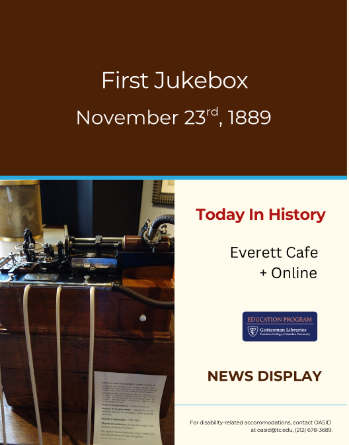
- Poster Image: Early Jukebox, Canva.
Need to keep current, look to the past, teach a topic? The Everett Cafe features daily postings of news from around the world, and also promotes awareness of historical events from an educational context. Be sure to check additional Cafe News postings on the library blog.