Today In History: John Dewey Is Born
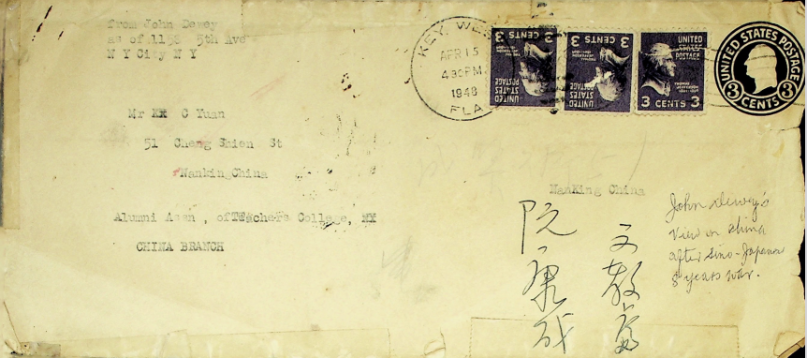
Science is still taught too much as if a separate study instead of being one of the most important factors in human life under the conditions that now prevail. From the early years science should be taught experimentally as the model of the pattern of thought and it should be taught in its bearings, in connection to the processes of lifting of the mass of people, farmers, mechanics, etc., as a means of making the necessary processes more intelligent and contributing better to the common welfare of all. The practical influence of science is not confined too much to specialized and technical occupations.
I would also suggest on the side of administration and organization the importance of a type of philosophy that avoids excess on the side of either extreme ce[n]tralization or extreme localization and diversification. It is important, it seems to me, that a country like China [has] a scheme [for] progressive unification of the country on one side, and due regard for the wealth of the local customs and traditions on the other side.
-- John Dewey to K.C. Yuan, 1948.
American philosopher, educator, and psychologist John Dewey was the third of four sons born to Archibald Dewey and Lucia Artemisia Rich Dewey on October 20th, 1859 in Burlington Vermont. One of the most prominent scholars in the first half of the twentieth century, Dewey wrote prolifically on democracy, pragmatism, and progressive education, with far-reaching influence in the United States and in foreign countries, among them China, Japan, and South Africa. He published approximately 40 books, in addition to 700 articles. From the Spring of 1919 until the Spring of 1921, he visited nearly a dozen provinces in China, delivering close to 200 lectures during his sabbatical, all the while advocating for Americans to support educational and social reform at home and abroad.
John Dewey attended public schools in his hometown before enrolling at the University of Vermont at the age of fifteen. He earned a doctorate from Johns Hopkins University in 1884, and was hired as an Assistant Professor at the University of Michigan. Four years later he left with his family to begin teaching as a philosophy professor at the University of Minnesota. Dewey's career took him to the University of Chicago where he headed up the philosophy department, while also serving as Director of the School of Education. He founded the University of Chicago Laboratory Schools for pre-kindergarteners through 12th graders. In 1904 he came to Columbia University where he was a professor of philosophy and also taught at Teachers College, Columbia University. He was one of the first seven professors to constitute the Department of Educational Research at Teachers College -- retiring eventually in 1930.
The Center on Chinese Education at Teachers College, Columbia University marked its 25th anniversary in 2025. Founded by the late Professor Emeritus of Economics and Education Policy Dr. Mun Tsang, it aims to contribute to a better understanding of education in China and to promote educational exchanges between the United States and China -- exchanges that reflect historic interest in China by John Dewey, Paul Monroe, William Heard Kilpatrick, Will McCall, and other leading progressive educators.
The following articles are drawn from Proquest Historical Newspapers, which informs and inspires classroom teaching and learning.
- Prof. John Dewey's Visit to China. (1919, May 17). Millard's Review of the Far East (1917-1919)
- Celebration of Dr. John Dewey's Birthday: Many Prominent Officials Gather To Do Him Honor. (1919, Oct 22). The Peking Leader (1918-1919)
- Bust Of Dr. John Dewey Presented To Columbia. (1928, Nov 10). New York Herald Tribune (1926-1962)
- Edman, I. E. (1929, Oct 13). Our Foremost Philosopher at Seventy: John Dewey Is Recognized in an Increasing Degree as One of the Deepest Influences in American Life. New York Times (1923-)
- Krotch, J.W. (1929, Oct 20). The Philosophy Of John Dewey. New York Herald Tribune (1926-1962)
- Byrne, G. (1935, Apr 29). Education: Some Teachers and Their Tactics: Dr. John. Dewey. South China Morning Post (1903-1941)
- John Dewey, 91, Has Visitors On His Birthday. (1950, Oct 21). New York Herald Tribune (1926-1962)
- John Dewey, 92, Philosopher Educator Dies: Figure in World Thinking for Half a Century Taught at Columbia 25 Years. (1952, Jun 02). New York Herald Tribune (1926-1962)
- Crist, J. (1952, Jun 08). The Man Who Changed Education: John Dewey's Universal Influence Survives Him. New York Herald Tribune (1926-1962)
- Mahanti, P. C. (1952, Aug 24). Aristotle of America: John Dewey, Philosopher of the Plain Man. The Times of India (1861-2010)
- John Dewey Fete Set: Columbia To Mark Birth Of Philosopher At Meeting. (1959, Oct 18). New York Times (1923-Current File)
- Krupnick, M. (1995, Sep 24). Liberal Saint: John Dewey, Who 'Brought Pragmatism into the Great World'. Chicago Tribune (1963-1996)
Tips:
- John Dewey Papers and Letters, 1895-1962, Columbia University, Rare Books and Manuscripts
- Center for Dewey Studies, Southern Illinois University
- Publications by or about John Dewey held at the Gottesman Libraries, in the Teachers College Digital Collections
- See additional archival collections on John Dewey in OCLC's Archive Grid, containing millions of records for primary source material held in archives, libraries, museums, and historical societies throughout the world
Images:
- Envelope. Dewey, J. (1949). John Dewey to K.C. Yuan, April 14, 1948 regarding Education in China. Education Manuscript Group 1, Courtesy of Teachers College, Columbia University.
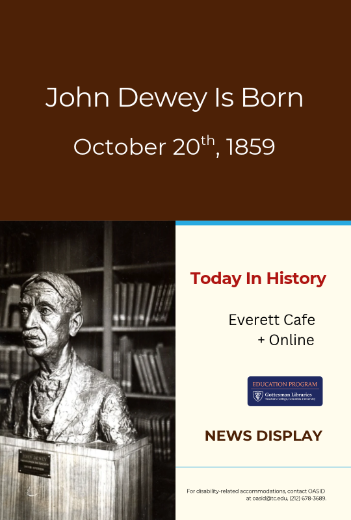
- Poster Image: Photograph of the Bust of John Dewey (in the Library) by Jacob Epstein, Courtesy of Teachers College, Columbia University.
Need to keep current, look to the past, teach a topic? The Everett Cafe features daily postings of news from around the world, and also promotes awareness of historical events from an educational context. Be sure to check additional Cafe News postings on the library blog.