Today In History: Yosemite National Park Is Established
By the time he was forty years old, John Muir had walked tens of thousands of miles, and he would walk more. His clothes had become tattered, his beard tangled with each year, his face deeply tanned and often covered with soot to shield him from the glare of the sun. He looked as wild as the wilderness he loved.
By the time he was fifty years old, he had decided to devote himself almost completely to writing and the cause of conservation. And finally in 1890, when Muir was fifty-two, his dream came true. A bill was passed and signed by President Benjamin Harrison, and Yosemite National Park was created. Soon there were more parks in California, including Sequoia National Park, where the immense thousand-year-old trees could now continue to grow and give shade in peace.
Kathryn Lasky, John Muir : America’s First Environmentalist
On October 1st, 1890 Yosemite National Park was established through an act of Congress which sought to protect over 1,500 miles of land that included vast meadows; large, stunning waterfalls; massive granite rock formations; and groves of giant sequoias, the world's biggest trees by mass and volume. One year prior, Scottish-American naturalist, writer, and conservationist John Muir had discovered that the meadows surrounding Yosemite Valley were being destroyed by domestic sheep. He wrote influential articles for The Century Magazine ("The Treasures of the Yosemite", August 1890, and "Features of the Proposed Yosemite National Park", September 1890) and lobbied to take action. With land unprotected by the federal government and the ecosystem at risk, the signing of the new bill by President Benjamin Harrison paved way for the recognition and protection of other large natural resources. Yosemite Valley and Mariposa Grove, both controlled by the state of California, would come under federal jurisdiction in 1906, while more national parks would be established, among them: Mount Rainier, in Washington (1899); Crater Lake, in Oregon (1902); Mesa Verde, in Colorado (1906); Glacier, in Montana (1910); Rocky Mountains, Colorado (1915); Denali, in Alaska (1917); Acadia, in Maine (1919), Grand Canyon, in Arizona (1919).
Located in the heart of the Sierra Nevada mountains, Yosemite National Park is famed not only for its beauty, but its wildlife, including mule deer, black bears, coyotes, mountain lions (pumas), the endemic Sierra Nevada bighorn sheep, hundreds of bird species, amphibians, lizards, fish, and thousands of plant species. Indigenous Americans were the first inhabitants of Yosemite Valley, followed by non-Indigenous miners and settlers as a result of the 1849 Gold Rush and westward expansion. As Yosemite's popularity grew across the country, tourism prompted the need for greater intervention and protection.
Today Yosemite National Park draws millions of visitors from around the world, and it is described as a "shrine to human foresight, the strength of granite, the power of glaciers, the persistence of life, and the tranquility of the High Sierra."
The following articles are drawn from Proquest Historical Newspapers, which informs and inspires classroom teaching and learning.
- The New Yosemite Park: It's Far Greater Than the Old One, Which It Surrounds and Protects. (1890, Nov 27). Daily American (1875-1894)
- A Good Year's Work: Secretary Noble Makes His Report. Many Important Subjects Discussed. Matters of Particular Interest to the People of California. (1890, Dec 01). San Francisco Chronicle (1869-1922)
- Rogers, L. (1952, Sep 07). Outdoor Paradise Found in Yosemite: Tour to Yosemite. Los Angeles Times (1923-1995)
- Freeman, I.H. (1977, Dec 18). The High Sierra Without Traffic: Yosemite and Sequoia Without the Traffic. New York Times (1923-)
- Scobie, W. (1979, Jan 21). The Million Year Old Valley. The Observer Magazine (1964-), , 40-41.
- Simross, L. (1983, Aug 07). Old, Young Say Yosemite Is the Place to Be. Los Angeles Times (1923-1995)
- Berkman, J. (1983, Sep 04). Yosemite: The Agony and the Ecstasy: Famed Park Is What Visitor Makes of It. Los Angeles Times (1923-1995)
- Cross, R. (1996, Apr 21). The Riddle of Yosemite: How Much Beauty Can One Small Valley in a Gorgeous Neighborhood Hold? Chicago Tribune (1963-1996)
- Cross, R. (1996, May 26). Mountain Majesty: Yosemite: The California National Park Is Home to Some of the Country's Most Scenic Natural Wonders. The Sun (1837-)
- Snibbe, K. (2024, Jun 30). Yosemite: On June 30, 1864. President Abraham Lincoln Granted Yosemite Valley and the Mariposa Grove to the State of California "for Public Use, Resort, and Recreation." The Hartford Courant (2008-)
Tips:
- Drabelle, D. The Power of Scenery : Frederick Law Olmsted and the Origin of National Parks. University of Nebraska Press, 2021. e-book.
- King, D. Guardians of the Valley : John Muir and the Friendship That Saved Yosemite. Scribner, 2023. e-book.
- Lasky, K., & Fellows, S. (2006). John Muir : America’s First Environmentalist (First edition). Candlewick Press. Curriculum ; QH31.M9 L37 2006.
- Murphy, Thos. D.-. (1925). Seven Wonderlands of the American West; Being the Notes of a Traveler Concerning Various Pilgrimages to the Yellowstone National Park, the Yosemite National Park, the Grand Canyon National Park, Zion National Park, Glacier National Park, Crater Lake National Park and the Petrified Forests of Arizona, by Thos. D. Murphy ... with Thirty-Two Reproductions in Color from Original Paintings by Thomas Moran, N. A., and Henry H. Bagg, and Twenty-Four Half-Tones from Photographs. Also Maps of the National Parks Covered by This Book. L. C. Page & Company c1925. e-book.
- McCully, E. A. (2004). Squirrel and John Muir (First edition). Farrar Straus Giroux. Juvenile ; PZ7.M478415 Sq 2004.
- National Geographic Society. (1988). Adventures in Your National Parks. National Geographic Society. Closed Stacks Curr ; GV191.4 .A37 1988.
- Spalding, M., & Cunha, S. (2017). Yosemite National Park. Core Library, an imprint of Abdo Publishing. e-book.
- Wenk, E., & Schaffer, J. (2018). Top Trails : Yosemite (Second edition.). Wilderness Press. e-book.
Images:
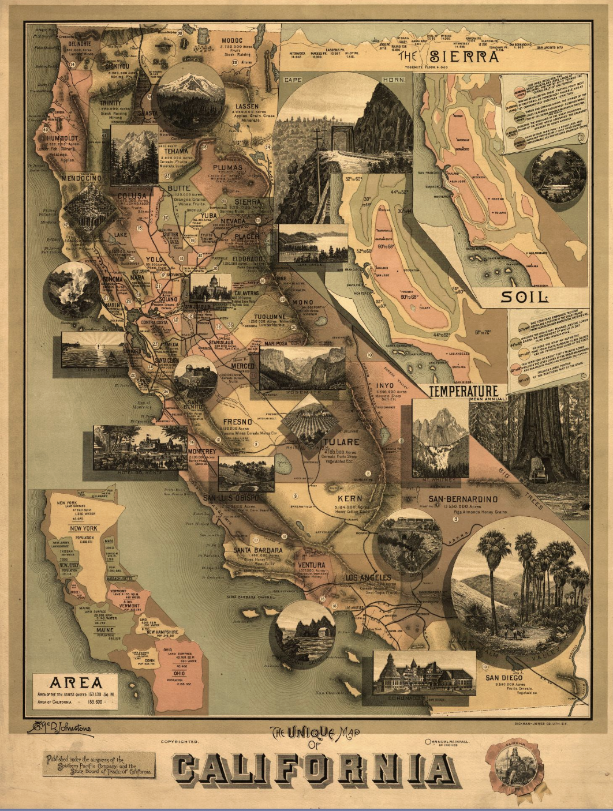
- Johnstone, E. M. & Dickman-Jones Co.Lith. (1888) The Unique Map of California. [S.l] [Map], Library of Congress Digital Collections.
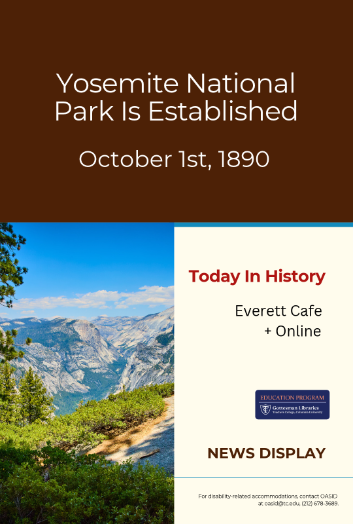
- Poster Image: Yosemite National Park, Canva.
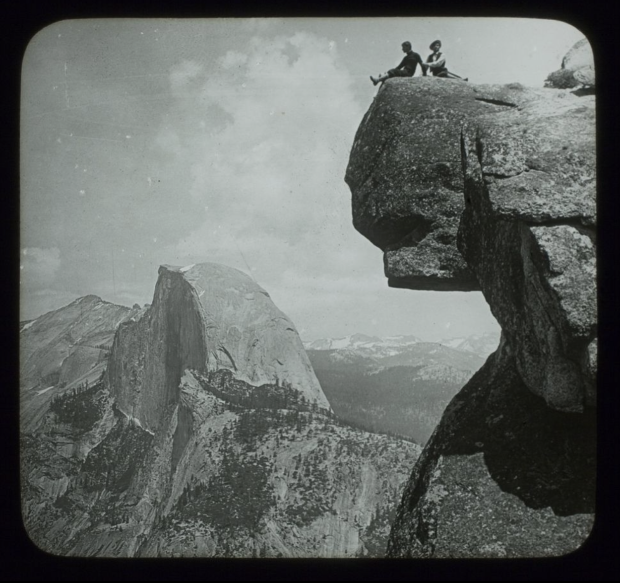
- Glacier Point Northeast, Yosemite Valley, Cal. (1931). Rothman Lantern Slide Collection, Teachers College, Columbia University.
Need to keep current, look to the past, teach a topic? The Everett Cafe features daily postings of news from around the world, and also promotes awareness of historical events from an educational context. Be sure to check additional Cafe News postings on the library blog.