A Journey Through Children's Books
Notes on Collecting and Curricula
The current display in the curiosity cabinets, The Journey, Physical or Metaphoric, in Classic Works of Children’s Literature, provides a glimpse into our rich collection of children’s books, in particular those children’s books that showcase physical and psychological journeys. As Library Director and Senior Librarian Jennifer Govan notes, such books illustrate, “how the educational process ultimately embraces continuous, dynamic personal growth through lived experiences, life’s hardships, and our adaptability as human beings.” These books consider how we learn and grow; how we move through the world; and how we come to understand each other. These titles also exemplify how children’s books have changed over time as both material objects and as repositories of culture and identity through story and illustration.
The curiosity cabinets display titles from several collections found within the library’s closed stacks, which are stewarded by the Special and Digital Collections Unit. The books on display signpost different stops on the evolutionary path of children’s books, showcasing everything from didactic and moral literature to fairy and fantasy stories to realistic fiction about the lives of children. In the cabinets are those classic stories about self-discovery and the wider world and by considering such books as material and historical objects, we can learn a little about how books were regarded in the past and understand what they can teach us in the present.
The Darton Collection and Children’s Books as Social History
One of the largest collections of rare and antiquarian children’s books at the Gottesman Libraries is the Darton Collection, named for its collector, Frederick Joseph Harvey Darton, English book collector and historian of children’s literature. The Darton Collection features some 1,400 titles of English children’s books published between the early 1700s through to the 1840s, as well as scrapbooks featuring book illustration sketches and a small collection of early children’s games. The collection was donated to Teachers College in 1939 by the American book collector Carl H. Pforzheimer, who was also a trustee of the college’s Horace Mann School for Boys.
The children’s books and games in the Darton Collection can provide insight into everyday lives of children in England and the Americas during the eighteenth and early nineteenth centuries. For collector F. J. Harvey Darton, children’s books, “more than greater or more famous literature, are the real social history of the country in which they were produced” (1924, p.1). The earliest printed texts in Darton’s collection, dating to the start of the eighteenth century, evidence many of the social, cultural, and economic problems of the day. Such texts react and respond to “stirrings in the social structure, as well as in industry, science, invention, religion, philosophy and education” (Moore, 1934, p. 183). These nursery rhymes, moral tales, fairy stories, and travel sketches are infused with Enlightenment philosophies, fears and fascinations regarding the Industrial Revolution, and the shifting theories of childhood and education posited by Locke and Rousseau (p. 183). These early books were among the first in English to be published for children, when moral and didactic tales prevailed (Demers, p.xv 2015; Moore,1934, p.175). The pages offered young readers instruction in conduct and accepted social behavior while also entertaining them through verse and illustrations (Darton, 1924, p.14; Demers, p.xv 2015; Moore, 1934, p.175). From books such as The History of Goody Two-Shoes, children learned manners and customs as well as letters, numbers, and geography. They were instructed in how to become “miniature adults” while also satisfying their “intellectual hunger,” their curiosity, and their wonder (Moore, p. 181 & p.184).
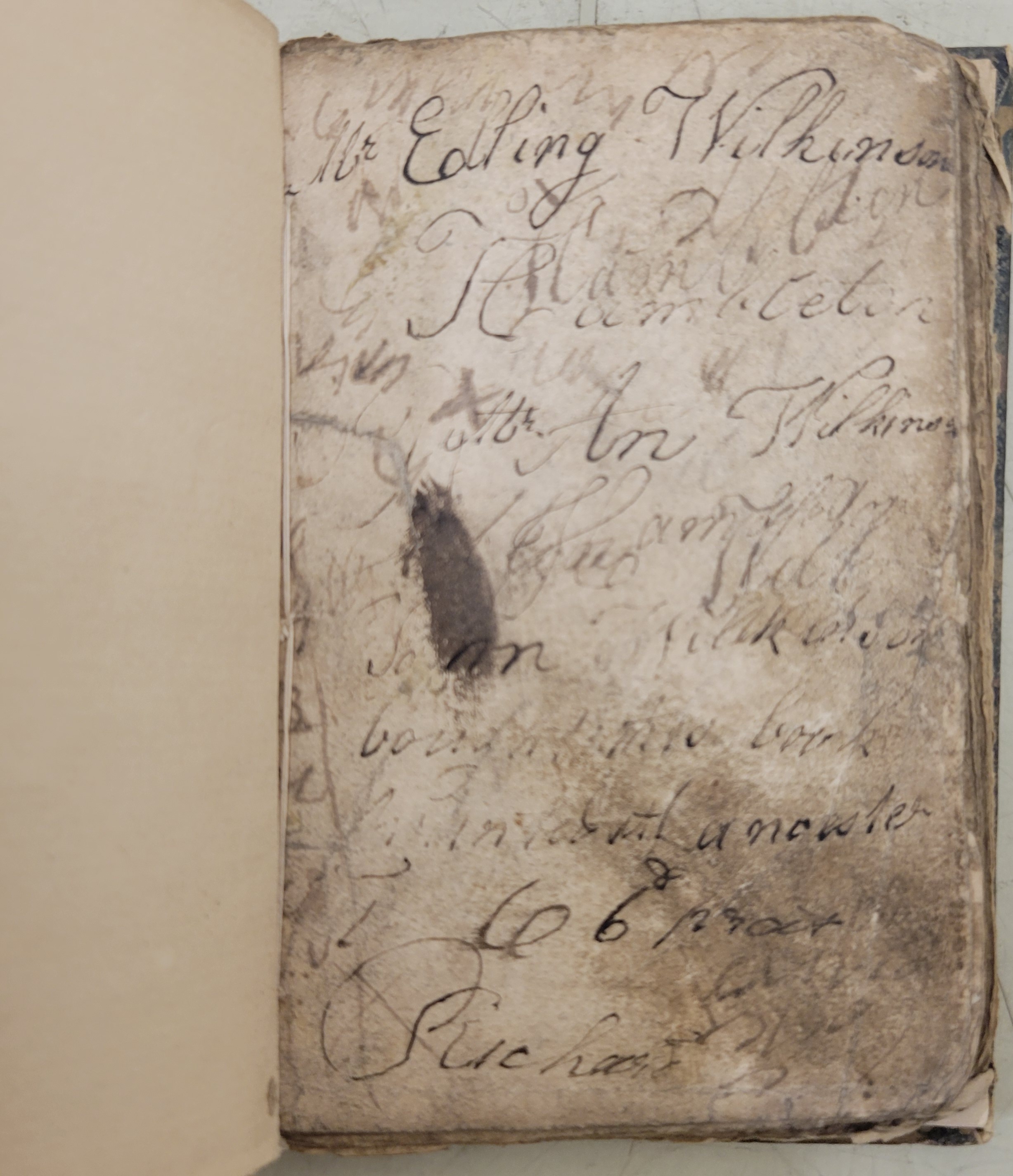
Books were cherished possessions for children in the past, often given as gifts or won as school prizes (Darton, p. 81; Demers, p. xv). In many of the books in the Darton Collection, there is evidence of children’s responses to what they read and traces of their ownership directly on the page. Through annotations and scribbles, children across history left their marks on their books (Darton, p. 83; Demers, p. xv). For example, in the Darton copy of The History of Goody Two-Shoes, previous owner Ellen Wilkinson marked her ownership by repeatedly writing her name on the endpapers. At times, she wrote her name in a cursive, looping script and at other times in emphatic bold letters, declaring the book as her copy. She also seemed to keep track of financial transactions, writing “six shillings and eight pence” in one corner.
Similarly, in Home and Its Joys, a previous child-owner sewed a cross-stitch sampler pattern above a hand-colored plate illustration on the frontispiece. It is easy to see the connection between the sampler’s idiom, “Home Sweet Home,” and the book’s themes of domestic safety and the protection of innocence. We can guess how the child owner understood the themes in relation to their own upbringing. Based on the image of the sampler and the quality of the book, we can only speculate what that upbringing might have looked like.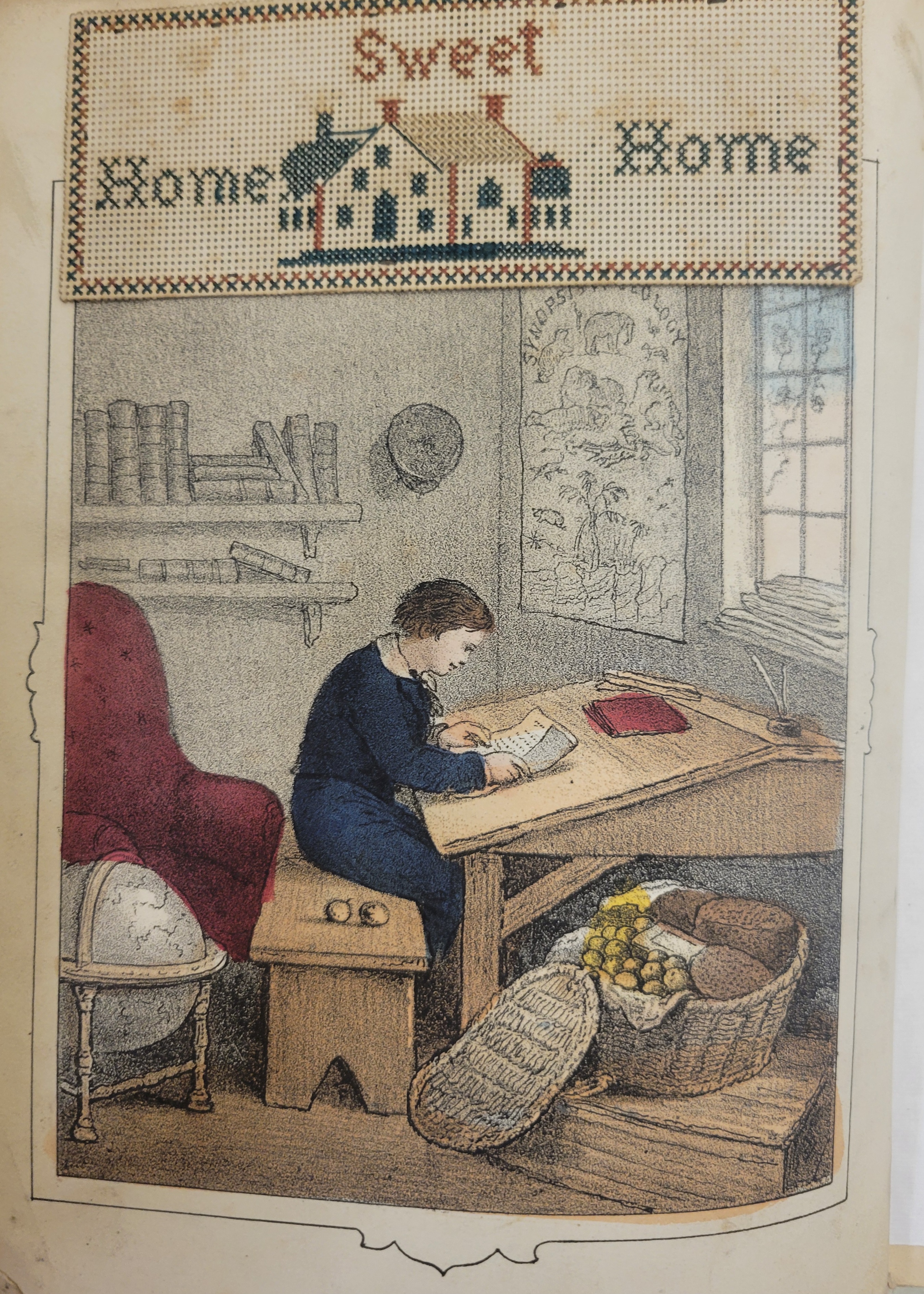
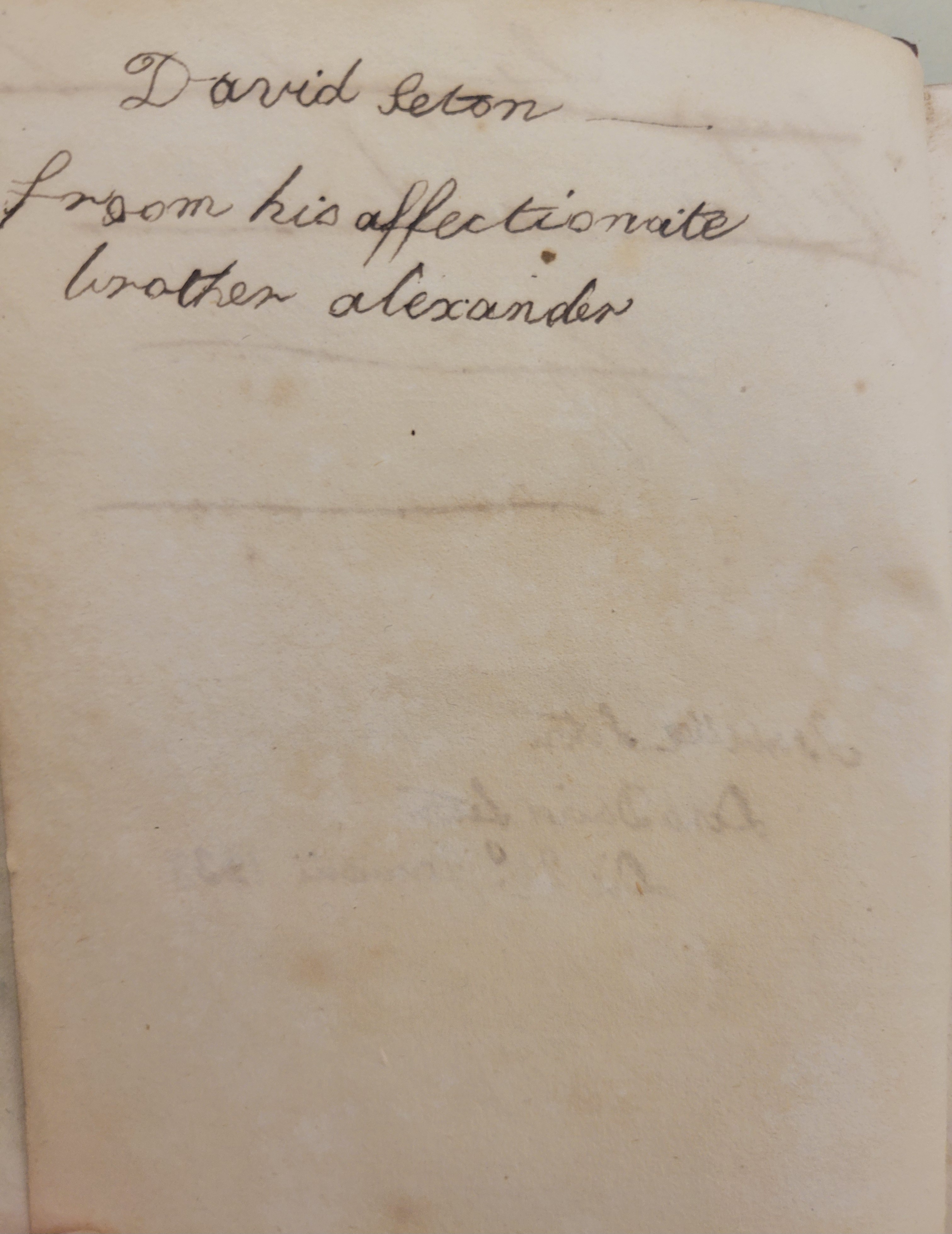
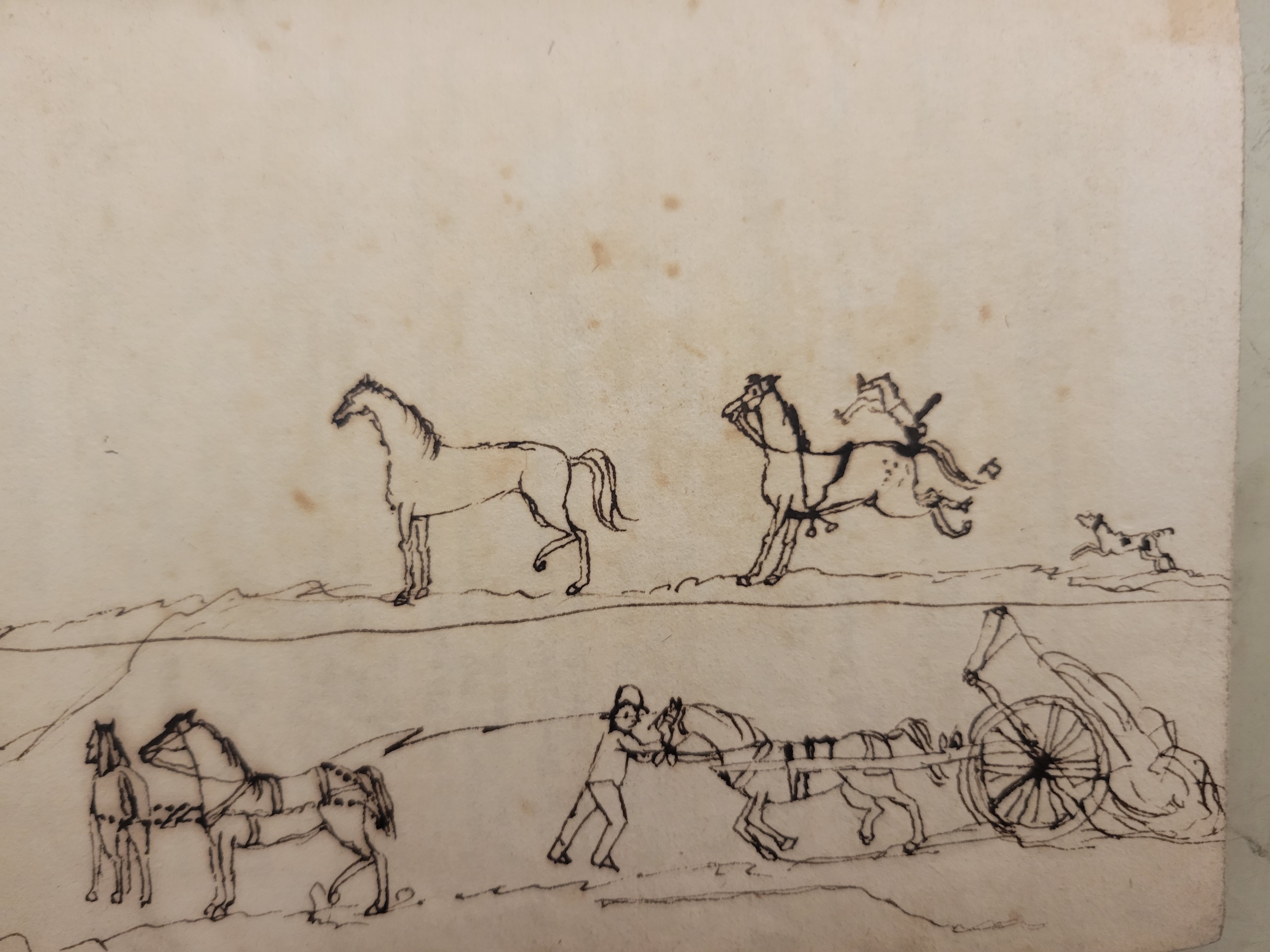
Another book in the Darton Collection that features a prominent trace of its child owner is Harry and William, or, The Two Cousins. The copy in the Darton Collection showcases hand-colored copper-plate illustrations, possibly colored by the book’s child owner, David Leton. It also contains drawings of horses on the endpapers. One horse bucks its rider, who falls backwards towards a little dog. Another horse pulls a cart, possibly filled with hay or manure. The carthorse is guided by a man, possibly a farmer. These drawings document a particular lived experience: that of farm labor and laborer’s relationships with working animals. There may not be much about David Leton in the historical record, but thanks to the annotations on the endpapers, we know he received the book from his brother Alexander and we know that David or his brother likely drew the horses, as they are done in the same ink as the inscriptions.
Harry and William is a tale that encourages moral qualities such as a love of nature and a propensity for industry. Perhaps through the drawing, David Leton was commenting upon the relationship between laborers and the land. Perhaps he was recreating scenes he saw in his everyday life. Whatever the case, in his book, he documented something about the moment in which he lived and left a trace of his existence, just as Ellen Wilkinson did and just as the previous owner of Home and Its Joys did. Books and scribbles such as these, among the many other children’s books in the special collections, can tell us about how children lived: what they saw, the way they dressed, the food they ate, how they learned, and what they valued.
Curriculum: What We Can Learn from Historic Children’s Books
While being rich sites of social history, children’s books also serve as resources for teaching and learning, enabling readers to embark on a journey of discovery through rhyme, image, and narrative play. Annie E. Moore, associate instructor of elementary education from 1910 to 1928 and professor of education from 1928 to 1932 at Teachers College, was also an avid collector of children’s books and wrote extensively on the teaching of children’s literature. She understood well the power of books for children and the need for such books to instruct and delight. In her 1934 monograph Literature Old and New for Children: Materials for A College Course, Moore outlines a comprehensive and rigorous college course on the subject, covering everything from the historical context of children’s literature across time to children’s psychological responses to books and reading. For Moore, children’s books such as Robinson Crusoe, The Tale of Peter Rabbit, and The Story of Ferdinand have endured over time because such literature “contribute[s] to a more sympathetic understanding of human motives and actions and thus … encourage[s] just and generous social attitudes” for literature “makes such a direct appeal to thought and feeling” (1934, p. 2). In this sense, books offer a safe way for children to learn about the world around them, to interact with it, and to imagine themselves in the lives of others.
Children’s literature, Moore noted, also offers “genuine aesthetic pleasure” and captivates children’s natural curiosity, their “delight in the sounds of words,” their “fresh and active imagination,” and their ability to feel “wonder … in experiences which are regarded as commonplace by most of their elders” (p. 257-259). The delight experienced in reading comes both from books’ aural and visual qualities as well as the stories held within their pages. Reading books aloud and engaging with their illustrations allow children to initiate themselves into the world of reading, into a place where they can see themselves in the story.
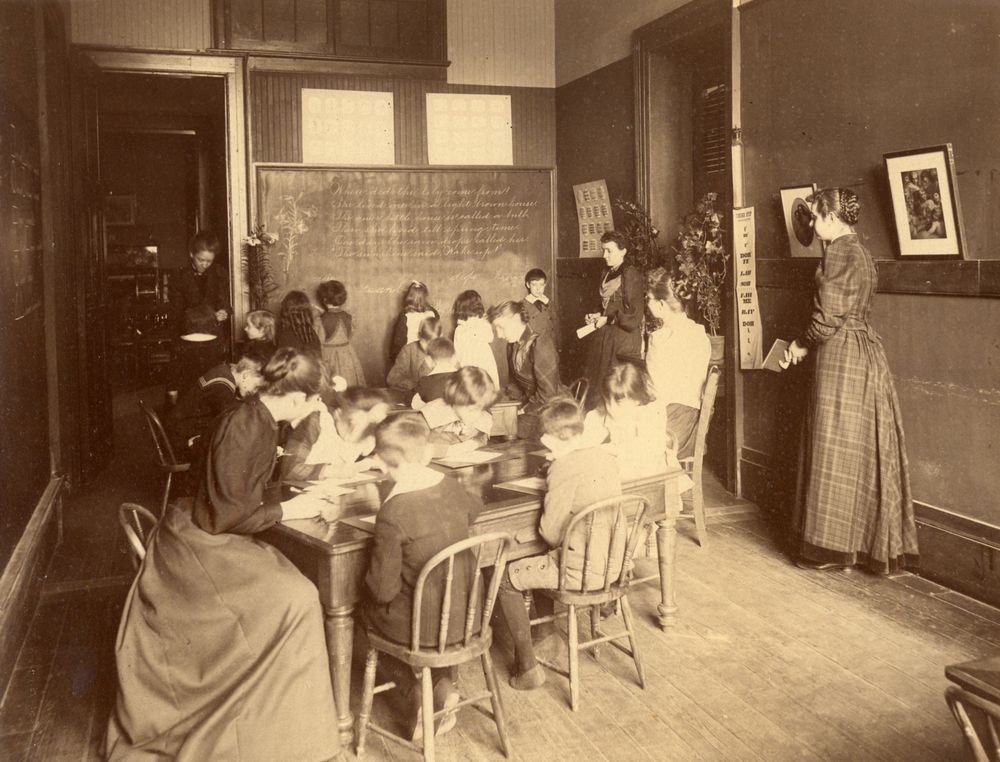
A contemporary of Moore’s, Anne Thaxter Eaton, school librarian at Teacher’s College’s Lincoln School from 1917 to 1946, similarly saw children’s books as powerful tools for coping with an ever-changing world. “A child has been made conscious through fairy tale and heroic legend that there is a world outside himself”, she wrote (1940a, p. 156). Juvenile literature, she felt, expands the boundaries of children’s lives, allowing them to engage with worlds both imaginary and real in a safe and controlled environment. Such stories offer amusement and instruction while simultaneously offering children characters that can “serve as an outlet and a healthy form of self-expression” for the things they cannot yet do (p. 156). For Eaton, poetry, fairy tales, travel stories, and book illustrations “stretch the mind as well as science and mathematics” (1940, p. 88). Such stories allow children’s imagination to grow and helps foster curiosity about the world. In classroom environments and classroom and in school libraries, children’s books can be used to learn about the past, ask questions about the present, and connect to lessons in all subject areas (Eaton, 1927, p. 53).
As the curiosity cabinets and the library’s collection of children’s books show, children’s literature holds an important place in both culture and in curriculum. Stories such as Where the Wild Things Are and The Witch of Blackbird Pond can help young readers and experienced readers find connection with the wider world and and with others. Books such as these transport us to the past, to the future, to fantasy lands, and to experiences we have not lived. These books endure because they are rich in their language and imagery and because they get at something real and true about human experience.
Works Cited
Darton, F. J. H. (1924). A note on old children’s books : (the Harvey Darton collection) ; A short bibliography of the Harvey-Darton Collection. [publisher not identified].
Demers, P. (2015). From instruction to delight : an anthology of children’s literature to 1850 (Fourth edition.). Oxford University Press.
Eaton, A. T. (1927). “Classroom Activities and the School Library,” The Horn Book Magazine,May 1927, vol. III, no. 2, pp 49-56. [Found in Anne Thaxter Eaton Papers, box 2]
Eaton, A. T. (1940). “Reading with children,” The Horn Book Magazine, March-April 1940, vol. XVI, no. 2, p. 83-94. [Found in Anne Thaxter Eaton Papers, box 2]
Eaton, A. T. (1940a). Reading with children. The Viking Press.
Moore, A. E. (1934). Literature old and new for children : materials for a college course. Houghton Mifflin.
Further Reading
Children’s Literature Research Guide
Provenzo, E. F. (1983). A Note on the Darton Collection, Special Collections, Teachers College, Columbia University. Teachers College Record (1970), 84(4), 929–934. https://doi.org/10.1177/016146818308400407
Tunnell, M. O., & Jacobs, J. S. (2013). The Origins and History of American Children’s Literature. The Reading Teacher, 67(2), 80–86. https://doi.org/10.1002/TRTR.1201