New Manuscript Acquisitions in Special Collections
Evolution of Education
A Collection of Manuscripts, Related to Education in the 18th- and 19th- Centuries
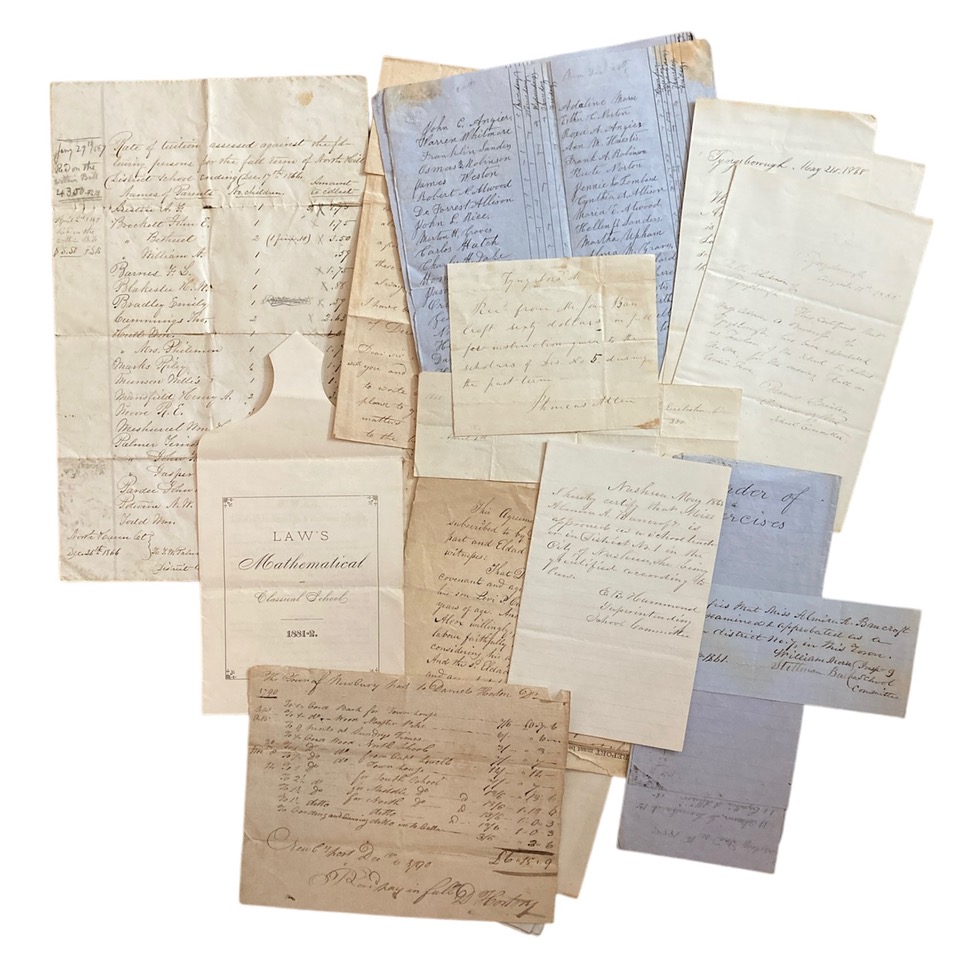
From various geographic locations, this material, dated 1790 - 1881, contains twenty-three letters, receipts, bills, partially printed documents, etc., related to children and adolescents and their education in the late 18th- and 19th- centuries.
An interesting and varied collection, spanning almost a century, it allows a glimpse into people's desire to educate the young and the expenses said education would incur, as well as the disparaging differences in the pay scale for male and female teachers in Victorian America. The earliest two items were handwritten receipts from 1790 and 1791. The first was from the Town of Newbury Port (i.e. Newburyport) to one Daniel Horton for various goods, including cords of wood for North, South, and Middle Schools. Known for its long history of educating its kids, from its creation in 1764, the town would support several small schools, most of which would operate in three-month intervals, with the teachers travelling from one to another, so all the children would get a chance. The second one was from Lemuel Fowler to Amos Whitmore - for the schooling of the former's son. A long, personal letter from 1799 by one Daniel Beckley of Sharon, Connecticut discussed various aspects of education and stated, several times, that he was in the "school business." An interesting grouping of letters from the 1860s, each signed by members of various school committees, attested to the fact that teachers at the time often rotated through different schools each term - in this case, one Almira A. Bancroft in Tyngsborough, Massachusetts. Each letter stated she had been examined, certified, and allowed to work as a teacher in various school districts of the town between 1861 and 1868. 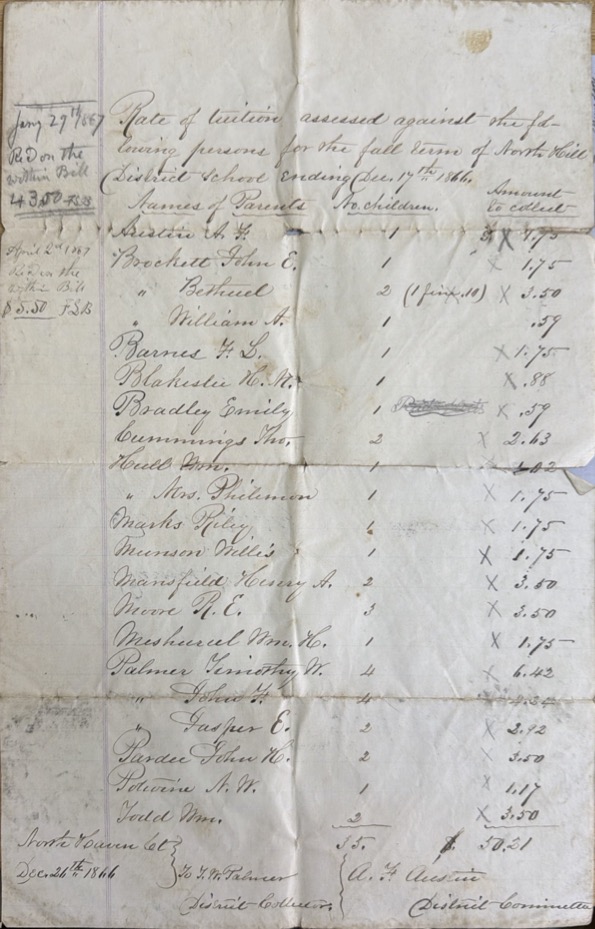
One of the most poignant of the documents was a large sheet, printed with 34 different columns and partially filled in manuscript - an exhaustive school report for the town of Cornish, New Hampshire. Apart from filling the number of students in each district, the number of teachers, the estimated value of school supplies, the lengths of terms, the textbooks recommended by the School Committee, etc. it also noted the wages of each male and female educator...and in every instance, the men's salaries were two to three times higher than those of the women. An 1827, lengthy, handwritten document by one David Curtiss of Wolcott, New York to Eldad Alcox bound Curtiss' son to Alcox, until the boy reached 17 years of age. The latter was to obey and to learn manners, morals, and agriculture. Alcox was to "send him to school; at least he is to be sent to school in the winter..." The most curious item and the only entirely printed one in the collection - a beautiful, die-cut, ruled pamphlet - announced the founding of Law's Mathematical and Classical School for both boys and girls, on the grounds of the Old United Presbyterian Church of East Salem, New York. It explained the goals, the management, the tuition fees, etc. Research has failed to find a record of the school having ever been in operation.
19th-century Art
A Small Collection of "American Textbooks of Art Education” by Smith, Walter
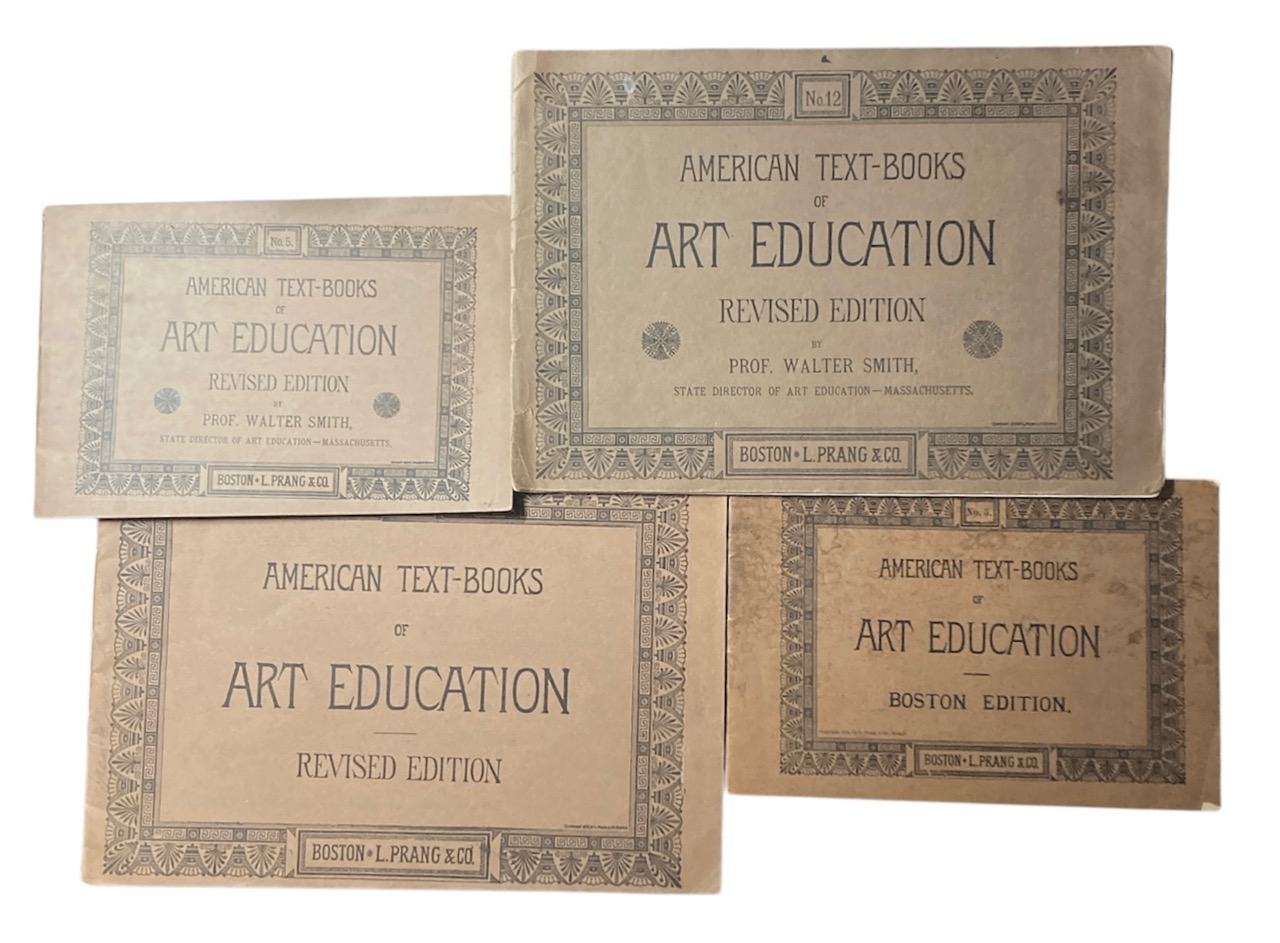
Boston: L. Prang and Co., 1878 - 1879. Four books - 'American Textbooks of Art Education, No. 5, Boston Edition,' 'American Textbooks of Art Education, No. 5, Revised Edition,' 'American Textbooks of Art Education, No. 12,' 'American Textbooks of Art Education, No. 13;' oblong 5 3/4 x 8 3/4 and 7 3/4 x 11 1/2 respectively. 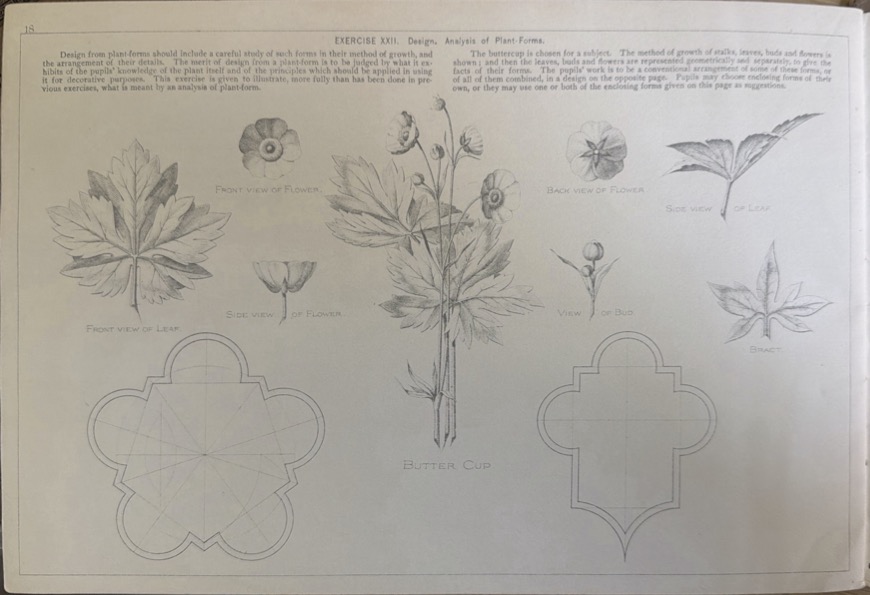
Walter Smith (1836 - 1886) was a British author, art educator, and one of the pioneers of industrial design in the United States. Emigrating to Boston in 1871, he would be appointed Massachusetts State director of Art Education and he would write a series of textbooks of art education and design, some of the first of its kind in the US, examples of which are the current ones. Example
include Egyptian and Roman style architectural elements, plant forms, ornaments, etc.
Vietnam War Era
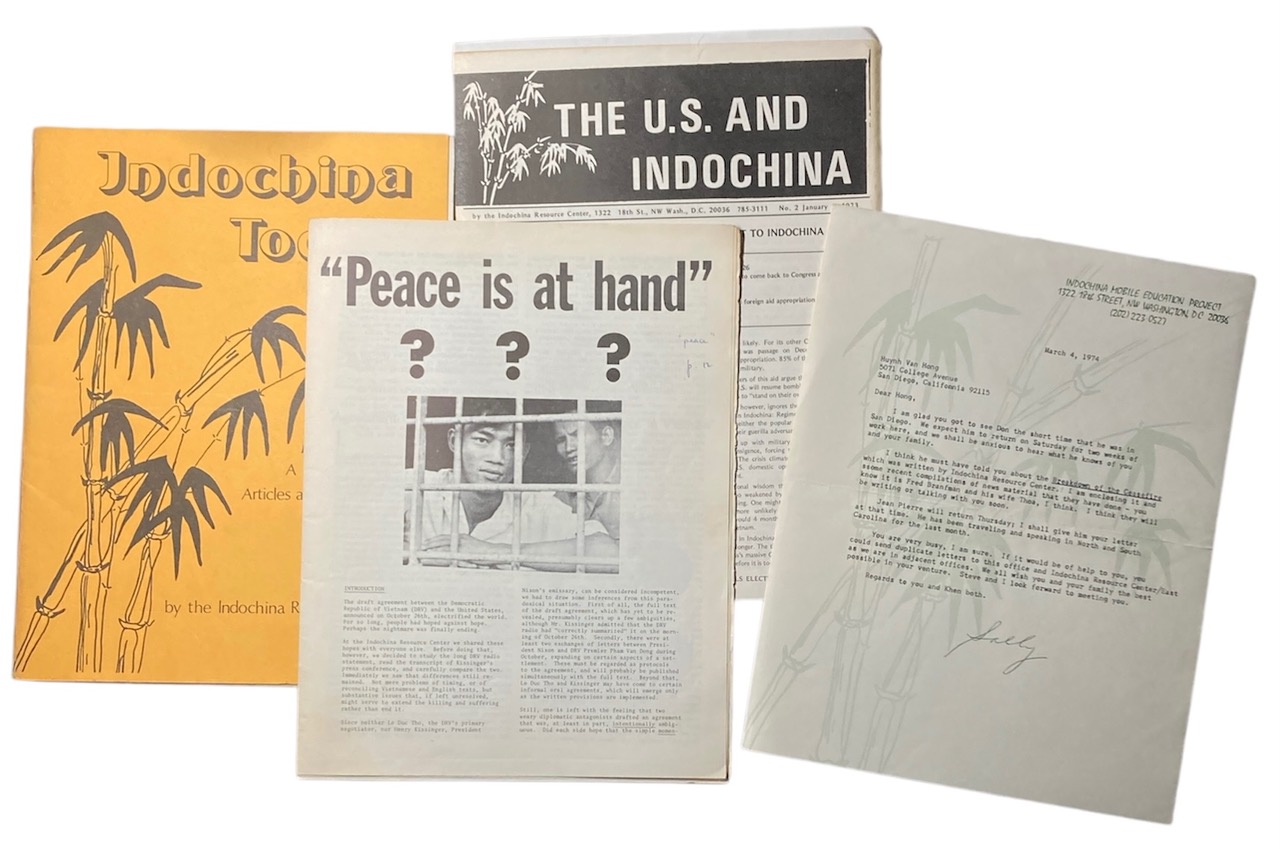
A Small Collection of Material, Published by the Indochina Resource Center
Washington DC: Indochina Resource Center, 1972 - 1974. Three publications and a typed letter, the latter signed in manuscript, by the Indochina Resource Center and the Indochina Mobile Education Project. Founded in 1971, the Indochina Resource Center served as an educational institution - informing the public, legislators, and the media about Vietnam, Laos, Cambodia, where U.S. military personnel were fighting. Research shows that the addressee of the letter - Huynh Van Hong - appears to have been a Vietnamese national, who had entered the United States in 1967, under the sponsorship of the Agency for International Development (AID), with a program for the education of future leaders of Vietnam. He would go into a protracted legal battle with the AID and the INS, when the former suddenly announced he was to be deported for being without a sponsor or other authority to remain in the United States.
Indochina Resource Center "The U. S. and Indochina" + "Special Congressional Insert - Indochina Legislation for 1974." Washington, DC, 1973;
Indochina Resource Center "Indochina Today, December 1973. A Compilation of Articles and Documents on Indochina." Washington, DC, 1973
Indochina Resource Center "Peace is at Hand." Washington, DC, 1972; pp. [20]; illustrated with photographs; a few small manuscript notes.
Indochina Mobile Education Project "Typed Letter." Washington, DC, 1974