New Exhibit: Carol Cade Children's Art: Part Three
First Floor
Introduction
The Carol Cade Children’s Art Collection comprises 532 mostly drawings and paintings, with some mixed media, created by young artists whose work was collected over decades by Carol Beth Cade, an avid teacher and painter from the South. Children of varying ages made them in family or neighborhood groups. College students asked them to draw pictures of themselves, something they enjoyed, or something they would like to do when they are older.
Cade’s collection presents a charming, comprehensive view of the artistic development of children, one that illustrates key stages of their artistic growth, from Scribbling and Pre-Schematic, to Schematic and Early Realism, through to Pseudo Naturalistic and Decision. In coordination with the Program in Art and Art Education, it was gifted to the Milbank Memorial Library (now Gottesman Libraries) of Teachers College, Columbia University in the early 1990s, building upon children’s art collections as a unique resource in the study and teaching of art.
Portions of the Carol Cade Children’s Art Collection were first shown at Pace University in 1991. Summaries of the artistic stages are drawn from Cade’s own narrative descriptions which include recommended classroom art materials for each stage of development. Cade’s curation lends interesting historical insight into her doctoral research at Teachers College and how the program in Art and Art Education would evolve innovatively in the following decades, with an examination of the role of the senses, emotions, and intellect in artistic development, and of the layered integrations they form over time, and with critical starting points for research.
On Carol Cade
Daughter to Reverend Charles David Cade and his wife Hope Tabor, Carol Beth Cade was born on February 22,1927 in the small town of Okolona near the western edge of Clark County, Arkansas. She spent much of her life in the greater Memphis, Arkansas area. She came to Teachers College in the late 1960s to undertake graduate research and completed her Ed’D in 1973 under advisement by Justin Schorr and William J. Mahoney with the dissertation, Color in Color Field Painting : Color in the Painting of Ellsworth Kelly, Kenneth Noland, and Frank Stella. In the early 1980s, Carol Cade served as Secretary for the Board for the University Council of Art Education at City University of New York.
She contributed a chapter, “A Minister’s Daughter Remembers” to Crisis of Conscience: Arkansas Methodists and the Civil Rights Struggle (Little Rock: Butler Center for Arkansas Studies, 2007), featuring personal stories by thirty Arkansas Methodist pastors, laypersons, and community leaders who lived through the struggles for civil rights in the 1950s. A former resident of Asbury Methodist Village, she recounts her father’s deep involvement, as well as her own awakening to racial attitudes and prejudices. New York, with its rich diversity in both art and education, was home to Cade who lived in Manhattan until her death at the age of 93.
On the Pseudo Naturalist and Decision Stage
Children from ages 11-14 are entering the next stage of artistic development where they tend to seek realism through application of concepts such as perspective, depth, light, and shadow. Despite their desire to portray real life, their artworks are close, but not totally accurate, sometimes appearing “stiff” in their portrayal of subjects – often themselves in various contexts or settings. Children are beginning to explore with greater depth and maturity their identity, values, emotions, social issues, and future careers, including those in art.
Around 13-17 years of age, children may decide to experiment more in art techniques and mediums, ultimately to decide whether they want to pursue art. They appreciate elements of space, color, and design, and may often express themselves in new and fresh ways. Their individuality emerges, coinciding with physical and mental growth, an increased awareness of emotions, and how they feel about their states of being.
References
Brief Life History of Carol Elizabeth Cade. Family Search.
Burton, Judith, et al. Beyond Dbae : The Case for Multiple Visions of Art Education, a Collection of Essays. University Council on Art Education, 1988. Oversize ; LB1591 .B39 1988.
Cade, Carol Beth. Color in Color Field Painting : Color in the Painting of Ellsworth Kelly, Kenneth Noland, and Frank Stella. New York: Teachers College, Columbia University, 1973. Closed Stacks Dissertations ; ND1489 .C33 1973.
Carol Cade Children’s Art. Teachers College Digital Collections.
Clemons, James T and Kelly L. Farr, eds. Crisis of Conscience: Arkansas Methodists and the Civil Rights Struggle. Burke Library E185.93.A8 C75 2007.
John F. Lidstone Collection. Minutes of the Board of the University Council of Art Education at City University of New York. Teachers College Digital Collections.
Milbrath, Constance. Patterns of Artistic Development in Children : Comparative Studies of Talent. Cambridge University Press, 1998. Stacks ; N351 .M54 1998.
Sickler-Voigt, Debrah C. Teaching and Learning in Art Education : Cultivating Students’ Potential from Pre-K through High School. 1st ed., Routledge, Taylor & Francis Group, 2020. e-book.
We Remember This Day. Bulletin of the St Paul and United Methodist Church. [New York]. November 1, 2020.
Acknowledgements
The Artistic Development of Children: Select Works from the Carol Cade Children’s Art Collection is made possible through the generous support of the Myers Foundations. It is curated by Jennifer Govan, Library Director and Senior Librarian and designed by Soeun Bae, Library Associate for Art and Design, with assistance from Kai Oh, fellow Associate for Art and Design.
Where: First Floor
When: November 26th - January 12th
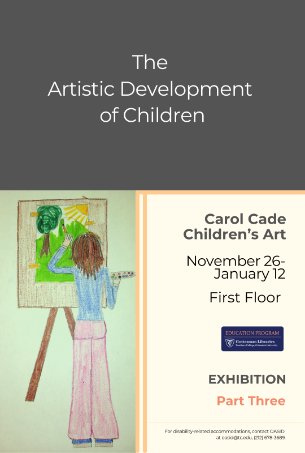
Poster Image: Dee Painting, from Carol Cade Children's Art, Courtesy of Teachers College, Columbia University.