Reflecting History: On Correspondence, In Conversation
Curated by Conrad Lochner, Special and Digital Collections Librarian, and designed by Kai Oh, Library Associate for Art and Design, this display offers a small glimpse from Gottesman Libraries large collection of twentieth-century letters written by faculty, students, and staff stationed around the world. These letters attempt to create a contextualized historical framework which offers viewers several potential avenues for a broad, yet critical, engagement.
The exhibition seeks to showcase the value of correspondence as a medium for dialogue—and certainly as researchers we come across those letters that speak to deep emotional involvement—almost as often as we sift through the seemingly banal communications of administrative functionality. However, both hold value in tuning into the relevant cultural and historic topography.
The letters showcase correspondence equally personal and intimate; at times the discourse and interaction offer a highly discretional and measured practice. When Aileen Hogan is penning letters home to her family from Europe during 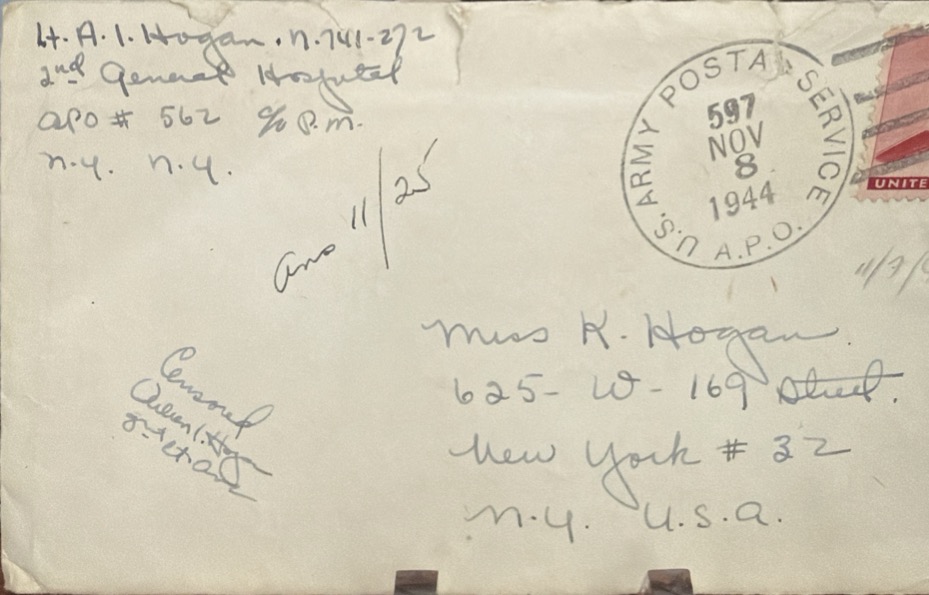 World War II, she does so under the entire bureaucracy of the United States Army as she deftly navigates rules of national security and censorship imposed by wartime protocol. On the other hand, when the Maxine Greene and Sue Middleton Correspondence Collection came to Teachers College, the institution was instructed to impose a 50-year embargo on digital access by the donor. In certain cases, the donor physically redacted material they believed to be too sensitive in regards to personal information that had the potential to dox certain
 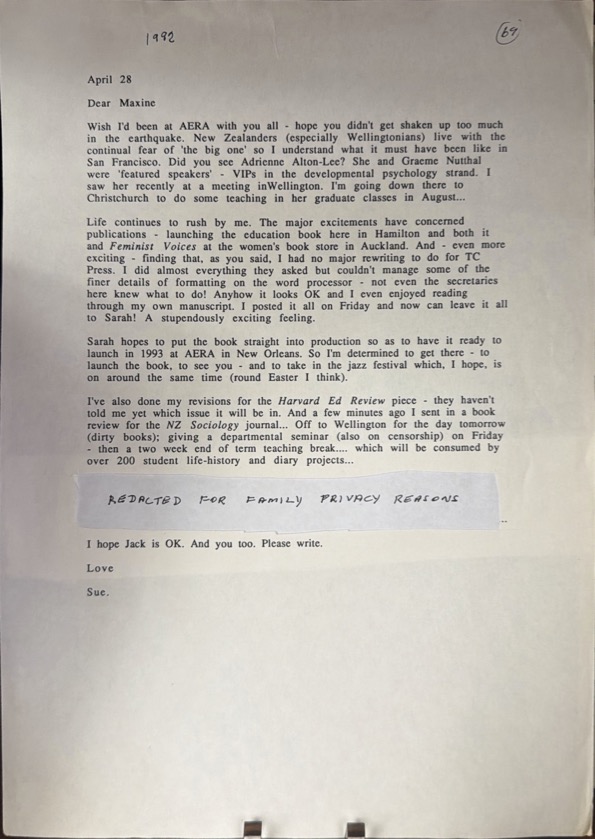 surviving family members.
Beyond the content of the letters themselves, there is an opportunity to examine Marshall Macluhan’s highly influential idea that the “medium is the message”. Indeed, within even the microcosm of Reflecting History: On Correspondence, In Conversation, we can bear a soft witness to the varying forms of deliverance, from Motamedi’s telegrams, Hogan’s V-mail, the Chisholm’s airmail, or the retained carbon copy of Charles Richard’s Letterbook. Each of these delivery methods displays a method of mediated communication that alters the speed at which the dialogue of correspondence is transmitted. At times, Hogan is responding to several letters at once as they all finally caught up to her at a new active-duty location, or she is lamenting the lack of letters though she later finds out they were simply hindered by the moving European Front. At other times, as with the diary of Elsa Meder of the Teachers for East Africa program, we see the slow accumulation of a diary that later becomes a source of administrative information in evaluation of the success of the program.
Through these written artifacts, visitors are invited to view a small slice of Teachers College educational contributions and personal journeys both at home and abroad. The exhibition spans service undertaken across the vast savannah plains of East Africa, the upper north island of New Zealand, the European Theater of Operations during World War II, our own campus on 120th Street, and the arid deserts and jagged mountains of Afghanistan.
Spotlight on the Collections
The exhibit features personal letters, photographs, textbooks, and unique historical materials from a broad array of select archival collections:
- Teachers for Education in East Africa: Discover perspectives on global teacher training through the Joan Hollobon Correspondence, Teachers in East Africa Correspondence (Sue Nanke Bruce), and the Teachers for East Africa - Elsa Meder Letters/Diary, where we can begin to look at the various role correspondence take, from the personal and private, to the public and policy.
- The Afghanistan Aid Projects: Dive into the mid-century educational missions in Afghanistan that served as crucial precursor programs to USAID. This section highlights the recently acquired papers of Edgar Klugman, an alumnus who served as a Methods and Materials Specialist in the 1950s working alongside the United States Operations Mission (USOM). It also features the records of Richard Chisholm (1960–1963) , which include teaching curricula, photographs, and student work, including significant material from Ahmad Ali Motamedi, Director General of the Antiquities of Afghanistan & Director of the Kabul Museum in the late 1960’s.
- International and Interpersonal Correspondence Read poignant letters from the Aileen Hogan Correspondence / World War II (Europe) detailing life on the front lines, alongside intimate and intellectual exchanges found within the Maxine Greene and Sue Middleton Correspondence.
- Institutional Foundations: Explore local histories through the George D. Strayer Testimonials (compiled upon his retirement) and the historic 1899 Letterbook of Charles R. Richard from the School of Manual Arts.
Explore More & Visit Us
The exhibition is currently on display at the Gottesman Libraries. For those looking to explore the finding aids, collection records, and digital assets associated with these historical projects, you can browse our curated digital repositories online: