Oh, The Things You Might Find!
Fun in an Air Raid Shelter
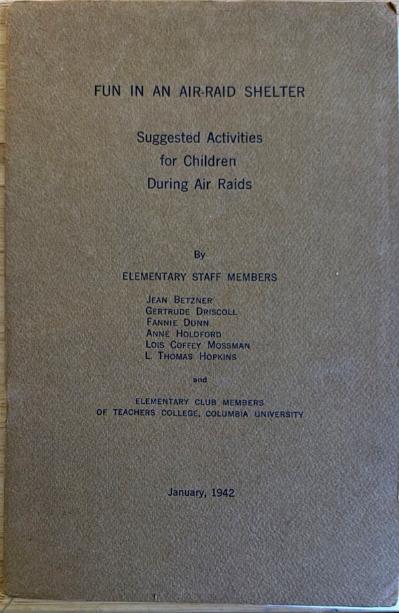
Our first species of ephemera that came across our desk was not actually found in the stacks, but sent originally to our Teachers College President Thomas R. Bailey from one Mr. Miller of Georgia. Mr. Miller located the pamphlet, Fun in an Air Raid Shelter: Suggested Activities for Children During Air Raids, at his parent’s house along the rolling hills of the Appalachian Ridge in Pennsylvania where they lived for over 60 years.
The book was published in 1942, written by the Elementary Education Group at Teachers College, Columbia University and manufactured by King’s Crown Press. The elementary staff members consisted of the following members—notable in their respective educational pursuits— Jean Betzner, Gertrude Driscoll ( (Emeritus),, Fannie Dunn (Emeritus), Annie Holdford, Lois Coffey Mossman, and L. Thomas Hopkins.
The title of the pamphlet does a considerable amount of heavy lifting when describing the content and, indeed, the publication offers 26 pages worth of suggestions to keep children not just busy during time during air raid shelter drills and occupation, but also foster an environment of cooperation. The staff provides a mix of activities including games and stunts (keep the kids moving), music in the form of singing games, various language-based games including riddles, limerick, and vocabulary. The subjects of fun also parallel other areas of curriculum such as science, literature, mathematics, nutrition, and arts and crafts.
We might be tempted to examine the relic through a lens of dismissive or curious bygoneism. However, the element of concern and uncertainty surrounding a world at war in 1942 was very visceral, and likely extra-so for a grade school aged child. The writers developed and addressed this book to children, encouraging
boys and girls….[to] help organize your class so that each person will have something to do. Vary your leaders. Select things you carry out in a short time. Create all the new and interesting things you can.
The committee open the floor to criticism and suggestion from the children in determining what is “interesting and valuable”, thereby deliberately developing the children as the experts for play.
Gottesman Libraries carries numerous monographs and publications—in a variety of fields—related to life during wartime including nursing, nutrition, physical fitness, general educations, mathematics, etc.:
- Dear Family: Lt. Aileen Hogan’s Correspondence from WWII
- My Dear Ms. Nutting: Personal Experiences of Nurses During WWI
- From Special Collections
Teachers College Registration Booklet
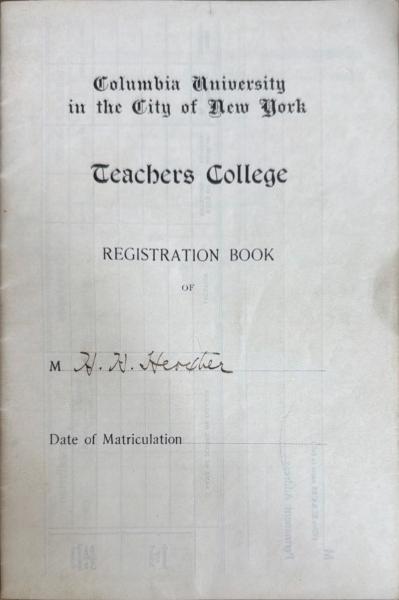
This beautiful relic of Teachers College past appeared, lodged in a folder in an uncataloged box apparently waiting for one of our librarians to find it. The Registration Book, belongs to one H.H. Hoexter pursuing their Bachelor of Science in Music, between 1903 and 1905. The registrar approves the courses during the fall semester—in the case in September of ’03 and October of ’04, and records them as complete with a red-inked stamp.
H.H. took ten courses, seven of which took place over the entirety of the academic year consisting of psychology, education, two literature courses (Goethe’s Faust and History of German Language), philosophy (History of Philosophy) and five music courses (counterpoint, adv. Harmony, analysis, and
two unlisted).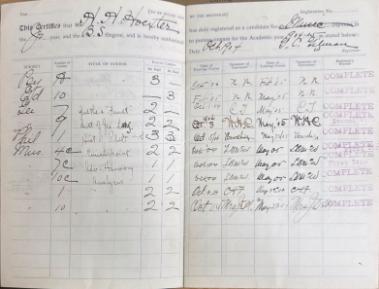
While only two of the eight registration pages are filled in, there can be some interesting deducations. One is obviously the how the introduction of various forms of technology have impacted the administrative process of tracking class completion for both students and the college. Another is that the student was obtaining a Bachelor of Science, where now we are solely a graduate school. This is also reflected in the classes—which might be termed general education—such as taking Literature courses. Most striking, at least to me, is how well preserved the paper is with this particular document. While there is some fading of the ink, and spotting where there had been adhesive, the papers does not show any sign of foxing, mold, brittleness or general deterioration.
For a further peek into the daily, administrative life at Teachers College, please consider the following digital collections:
- Teachers College Announcements, Annual Reports, and Catalogs
- Official Documents Collection
- Publications of Teachers College
- Historical Photograph Collection
What is a Laboratory Practice
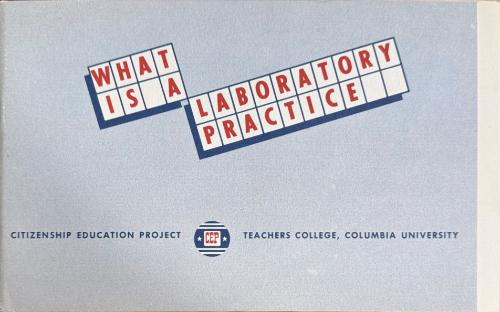
This third edition of What is a Laboratory Practice was printed in 1954 in support of the Citizenship Education Project (CEP). Began in 1949 and ending in 1957, CEP was an initiative by Teachers College—funded by the Carnegie Foundation and supported by Dwight Eisenhower and William F. Russell—to bring innovative curricula and methods to the social studies education in the United States. What is a Laboratory Practice provides a methodology towards the practice and praxis for both students and teachers participating in the CEP learning unit.
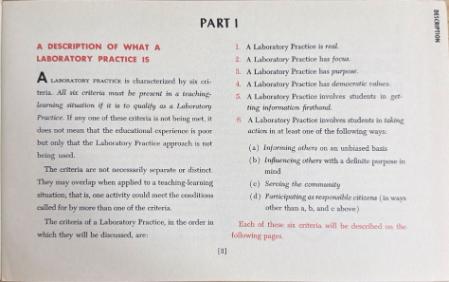
There are six specific criteria that define laboratory practice, if any one of the six goes unmet it means that the “Laboratory Practice is not being used”:
- A Laboratory Practice is real
- A Laboratory Practice has focus
- A Laboratory Practice has democratic values
- A Laboratory Practice involves students in getting information first hand
- A Laboratory Practice involves taking action in at least one of the following ways:
- Informing others on an unbiased basis
- Influencing others with a definite purpose in mind
- Serving the Community
- Participating as responsible citizens (in ways other than a, b, c above)
The methodology goes on to describe, in some detail, each of the six criteria—all of which look to engage students in the active participation in the process of “good citizenship”. The framework for the methodology hinges on criteria
number four, democratic values, in that the student must “understand the premises in the Tradition of American Liberty”. These premises are generally understood, within the context of the CEP and the immediate post-war era, as “rights, responsibilities, aspirations, and principles that have been and still are guideposts to our country’s policies”, though there is nothing by way of defining those values.
For more information on the Citizenship Education Project, please consult the following resources: